Leadwort-leaved commicarpus
Commicarpus plumbagineus
Description
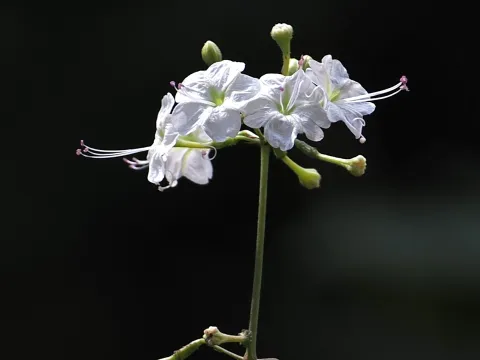
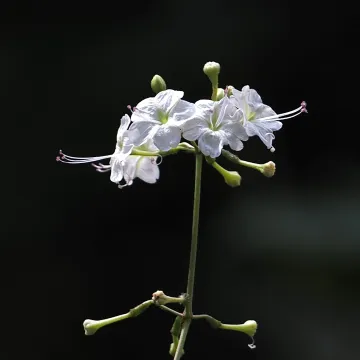
Leadwort-leaved commicarpus (Commicarpus plumbagineus) is a perennial herb or subshrub belonging to the Nyctaginaceae family. It is recognized for its trailing or climbing habit, often found spreading across rocky terrain or using other vegetation for structural support.
The plant originates from tropical and subtropical areas, spanning across Africa, the Middle East, and parts of Asia. It is highly adapted to arid and semi-arid environments, thriving in habitats where many other cultivated species might fail due to lack of water or poor soil quality.
Botanically, it features opposite leaves and small, cluster-borne flowers. The fruits are distinctively sticky, equipped with specialized glandular hairs that enable them to attach to passing animals, which serves as the primary mechanism for seed dispersal in its natural habitat.
For cultivation, this species requires well-draining soil and a location with full sun exposure. It is highly sensitive to waterlogging, which can cause root decay. Given its natural habitat, it requires minimal irrigation once established, making it a sustainable choice for xeriscaping or low-maintenance landscapes.
Beyond its ecological role, the plant holds value in traditional medicine, where various parts are utilized for their potential anti-inflammatory and antiseptic properties. It is also studied for its soil-binding capabilities, which help prevent erosion in degraded arid environments.
- Excellent adaptation to drought and heat.
- Ability to thrive in nutrient-poor and rocky substrates.
- Sticky fruit mechanism for wide distribution.
- Potential use in soil stabilization and ethnomedicine.
Photo gallery