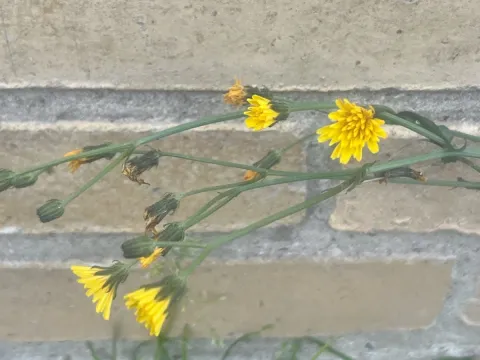

Smooth hawksbeard
Crepis capillaris (L.) Wallr.
Description
Smooth hawksbeard (Crepis capillaris) is an annual or biennial herbaceous plant belonging to the Asteraceae family. While it is not considered a cultivated crop, it is a significant weed species that agricultural producers frequently encounter in various cropping systems and grassland environments.
Native to Europe, this species has successfully naturalized across temperate regions worldwide, including North America and parts of the Southern Hemisphere. Its adaptability allows it to thrive in diverse environments, ranging from fertile agricultural soils to disturbed sites such as roadsides and urban waste areas.
Botanically, the plant is characterized by a basal rosette of leaves and a slender, branching stem that can reach heights of up to 60 cm. Its yellow, dandelion-like flowers are clustered into heads and produce small seeds equipped with pappi, facilitating wind-based dispersal. This mechanism allows the plant to spread rapidly across wide fields.
In terms of agricultural management, controlling Smooth hawksbeard is crucial to preventing yield competition. Cultural practices, such as crop rotation, competitive planting, and timely mechanical cultivation, are effective. The species generally prefers open, sunlit areas and thrives in well-drained loamy or sandy soils, often appearing in large clusters if left unmanaged.
From a pest management perspective, this weed can act as an alternative host for various pests and diseases that affect commercial crops. Typical issues include susceptibility to aphids and fungal pathogens like powdery mildew. Effective control programs should integrate chemical intervention with soil management techniques to minimize the seed bank in the topsoil.
Photo gallery