
Pride of Madeira
Echium candicans L. f.
Description
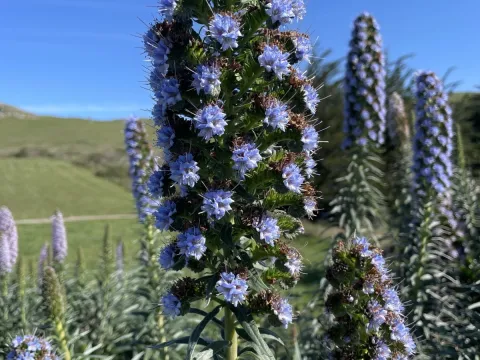
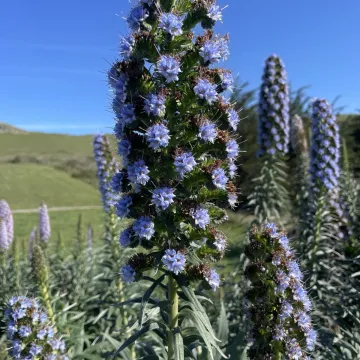
Pride of Madeira (Echium candicans L. f.) is a woody, perennial shrub belonging to the Boraginaceae family. Renowned for its dramatic, cone-shaped flower spikes and grey-green foliage, this plant is a staple in Mediterranean-style gardens due to its striking appearance and resilience in dry climates.
Native to the island of Madeira, this plant thrives in temperate, coastal environments. It is widely cultivated in various parts of the world with similar Mediterranean climates, including parts of Australia, California, and Southern Europe. It is not cold-hardy and requires protection in regions where temperatures drop significantly below freezing.
The plant exhibits a robust structure, often reaching up to 2.5 meters in height. Its leaves are lanceolate, arranged in dense rosettes, and covered in fine hairs that give them a silvery sheen. The inflorescence, blooming in late spring, consists of thousands of small, brilliant blue-purple flowers that are highly attractive to pollinators.
Cultivation success depends on high light exposure and superior soil drainage. Echium candicans is highly drought-tolerant once established and performs best in poor, rocky soils. Over-fertilization should be avoided, as it promotes leggy growth and reduces the plant's natural resistance to environmental stress and fungal pathogens.
Key applications include:
- Ornamental garden design and landscape restoration.
- Providing significant forage for honey bees and beneficial insects.
- Creating large, informal shrub borders in seaside gardens.
- Container gardening for patio displays in cooler climates.
In terms of plant health, the species is susceptible to root rot if grown in heavy, waterlogged soils. Common pests include aphids and spider mites, which can be managed through natural predators or targeted horticultural soaps. Maintaining proper air circulation around the canopy is essential to prevent fungal infections such as powdery mildew.
Photo gallery