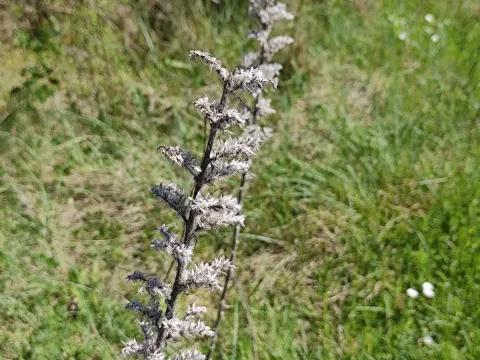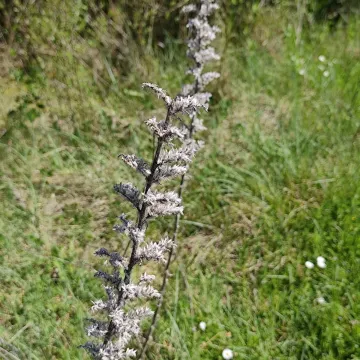
Italian viper's bugloss
Echium italicum L.
Description
Italian viper's bugloss (Latin Echium italicum L.) is a biennial herbaceous plant belonging to the Boraginaceae family. Unlike many other members of the genus, this species is noted for its tall, branching inflorescences which can reach up to 1.5 meters in height. It develops a robust taproot system that ensures its survival in challenging environments.
The native range of this species extends across the Mediterranean basin, Southern Europe, and parts of Western Asia. It typically thrives in open, sunny locations with dry, rocky, or sandy substrates. Due to its Mediterranean origin, the plant is remarkably drought-tolerant, making it an excellent candidate for cultivation in arid climates or marginal agricultural land.
Botanically, Echium italicum is characterized by dense, bristly hairs covering its stems and leaves, an evolutionary adaptation to minimize transpiration. The plant exhibits a rosette of basal leaves in its first year, while in the second year, it produces a dramatic, paniculate inflorescence featuring numerous small, white to pale pink or bluish flowers. This structure provides a large surface area for pollinators.
In terms of agronomy, the plant prefers well-drained, slightly alkaline soils. Seeds are typically sown in early spring. Once established, the crop requires very little maintenance, including minimal fertilization and no irrigation. Weeding during the first growth stage is crucial, but once the canopy closes, the plant is highly competitive against surrounding weeds.
The primary economic value of Italian viper's bugloss lies in its exceptional nectar production, making it a highly prized plant for apiculture. Beekeepers value the species for its long blooming period and high sugar content in its nectar. Additionally, it is used for soil stabilization projects to prevent erosion on hillsides and in xeriscaping, where water conservation is a priority.
Photo gallery