Miss Willmott's ghost
Eryngium giganteum M. Bieb.
Description
Miss Willmott's ghost (Eryngium giganteum) is a striking herbaceous perennial belonging to the Apiaceae family. While it is technically a perennial, it is frequently cultivated as a biennial, as it reaches its peak structural beauty in its second year before setting seeds and subsequently declining.
Originating from the Caucasus region, this plant is naturally adapted to rugged, rocky, and well-drained habitats. Its evolutionary history in mountainous terrain explains its excellent tolerance for poor soil conditions, drought, and exposure to the elements in cultivated garden settings.
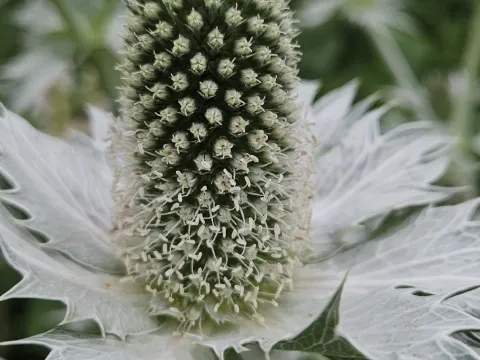
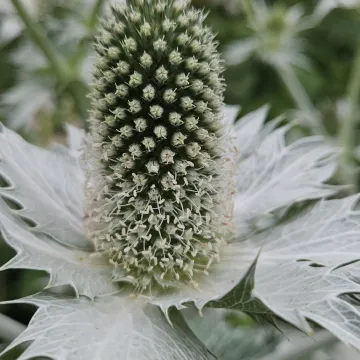
The plant is defined by its robust, upright stature, often growing up to 120 cm in height. Its most notable features are the large, heart-shaped basal leaves and the architectural, prickly bracts that surround the central cone-shaped flower heads, which transition from pale green to an intense steely blue during the summer season.
Successful cultivation requires full sun exposure and gritty, well-draining soil. It thrives in soils of low to average fertility and is highly sensitive to winter wetness, which can cause crown rot. Propagation is most efficiently achieved through direct sowing in late summer or autumn, allowing for natural stratification over winter.
Horticulturally, this plant is a staple in prairie-style gardens and contemporary borders due to its structural form. It is also highly prized as a cut flower for both fresh and dried arrangements. It is generally untroubled by pests, though growers should be vigilant for slugs on young seedlings and occasional powdery mildew if air circulation is poor.
Photo gallery