
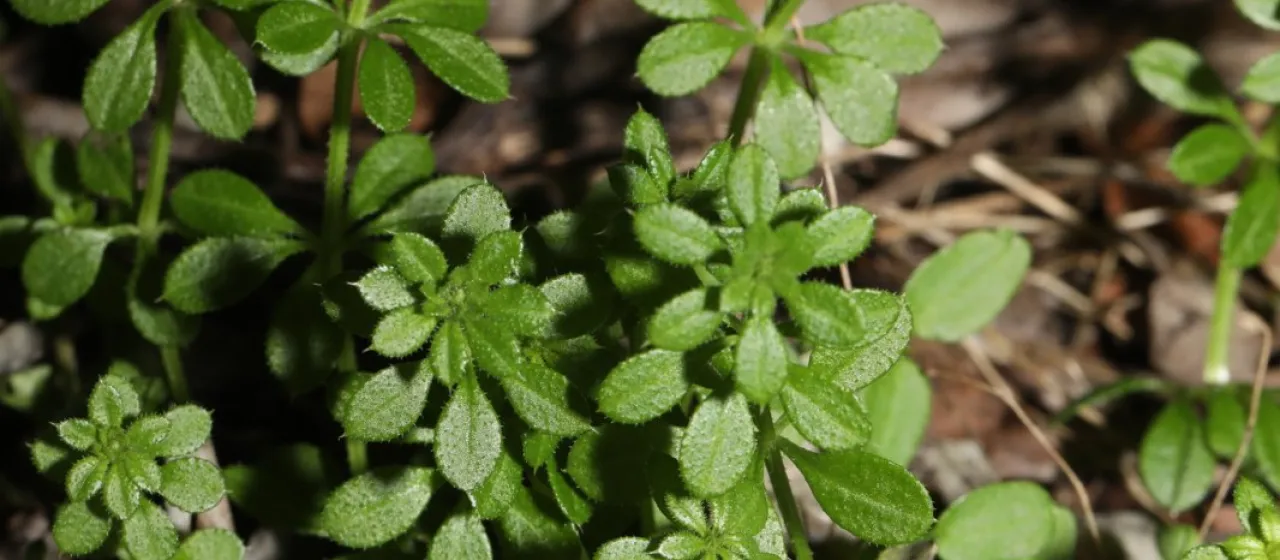
Description
Cleavers (scientific name: Galium aparine L.) is an annual herbaceous plant belonging to the Rubiaceae family. In agricultural settings, it is recognized as a persistent and troublesome weed that competes vigorously with cultivated crops for nutrients, sunlight, and moisture, often leading to substantial yield reductions.
Originating from Europe and parts of Western Asia, cleavers has established itself as a widespread weed globally. It thrives in diverse climates, particularly in the temperate zones. The plant displays a strong preference for nitrogen-rich, moist soils, making it a frequent invader in cereal fields, orchards, and open cultivation areas.
The botanical structure of cleavers is highly adapted for climbing. The stem is square-shaped and covered in tiny, hooked hairs that grip onto surrounding vegetation, allowing the plant to reach heights of over a meter. Leaves are arranged in whorls along the stem. This structural adaptation allows it to smother crops and cause lodging, which complicates harvesting processes significantly.
Agronomic management of cleavers requires precise timing and integrated methods. Cultural practices, such as competitive crop rotation and rigorous seedbed preparation, are essential to limit early growth. Chemical control remains the most common method, utilizing selective herbicides during the early stages of development. However, due to its ability to germinate over an extended period, multiple treatments may be necessary.
From a хозяйственное perspective, cleavers causes economic losses by not only competing with the crop but also contaminating grain harvests with its sticky seeds. While it is rarely a primary host for major crop pests, the dense canopy it creates can maintain high humidity levels, indirectly promoting fungal diseases within the crop stands. Proper monitoring is vital to prevent the establishment of a large seed bank in the soil.
- Highly effective climbing mechanism for dominance.
- Significant seed bank longevity reaching up to a decade.
- Major impact on harvest efficiency due to plant structure.