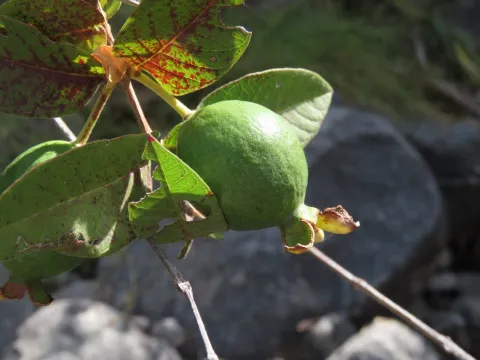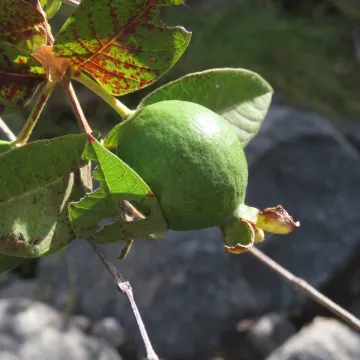
Common guava
Psidium guajava L.
Description
Common guava (Psidium guajava L.) is a prominent evergreen shrub or small tree belonging to the Myrtaceae family. Widely recognized for its delicious fruit, the guava is a staple in tropical agriculture, highly valued for its intense aroma, distinctive flavor, and impressive profile of vitamins and dietary fibers.
Native to tropical regions of the Americas, the common guava has successfully naturalized across various tropical and subtropical landscapes globally. Its ability to thrive in diverse environments has made it a significant cash crop for many countries in Southeast Asia, Africa, and Latin America, where both climate and soil conditions favor its robust growth.
Botanically, Psidium guajava is characterized by a sprawling growth habit and thin, smooth bark that peels off to reveal a greenish surface. The leaves are opposite, elliptic, and feature distinct venation. The flowers are typically white, solitary or clustered, and possess an appealing scent that attracts essential pollinators like bees, which are vital for fruit production.
Successful guava cultivation requires a frost-free environment with plenty of sunshine and consistent warmth. While the tree is remarkably adaptable to various soil types, it performs best in well-drained, sandy loam soils with a slightly acidic to neutral pH level. Effective orchard management requires strategic pruning to manage canopy density, which facilitates better light penetration and enhances fruit development.
- Regular irrigation during dry seasons is crucial for fruit set.
- Nutrient management via NPK fertilizers ensures optimal yields.
- Strategic thinning of fruit to improve overall fruit size and quality.
- Integrated pest management (IPM) to control fruit flies and beetles.
In terms of agricultural and commercial use, guava is incredibly versatile. It is consumed fresh, processed into juices, pastes, and jams, and serves as a major ingredient in the beverage industry. Beyond the fruit, the leaves are increasingly harvested for their medicinal compounds, particularly for their anti-inflammatory and antibacterial properties in traditional and modern medicine.
The crop faces pressure from various biological stressors, including fungal infections like anthracnose and various types of root rot triggered by waterlogged conditions. Pests such as fruit flies, scale insects, and aphids require vigilant monitoring and preventative measures to ensure high-quality marketable harvests. Maintaining orchard hygiene is the primary defense strategy for commercial guava growers.
Photo gallery