Cattley guava
Psidium cattleianum Sabine var. cattleianum
Description
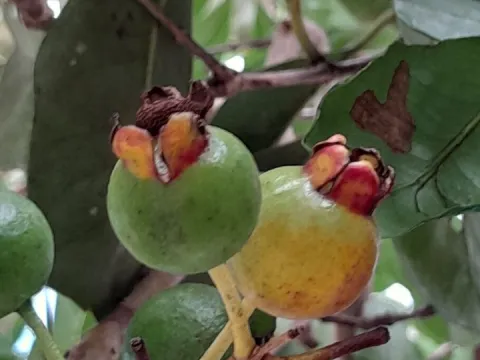
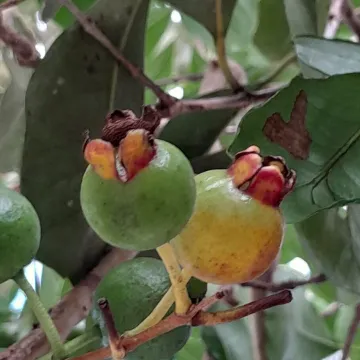
Cattley guava (Latin: Psidium cattleianum var. cattleianum), also known as the strawberry guava, is a perennial evergreen shrub or small tree belonging to the Myrtaceae family. It is recognized for its robust growth habit and its ability to thrive in various subtropical and tropical environments.
Native to Brazil, the species has naturalized in several parts of the world, including Hawaii, parts of the southern United States, and areas in Asia. Its resilience makes it an excellent candidate for both home orchards and commercial production where suitable microclimates are maintained.
The plant features glossy, deep green, leathery leaves and produces small, white, fragrant flowers. The fruits are round berries with a smooth, thin skin that turns deep red or dark purple when ripe. The pulp is succulent, sweet-tart, and aromatic, containing numerous hard seeds, which is a common characteristic of this genus.
Agronomic requirements include full sun to partial shade and fertile, well-draining soil with a slightly acidic pH. While the tree can withstand cooler temperatures than the common guava (Psidium guajava), it is sensitive to severe frost. Consistent irrigation is critical during the fruit development stage to ensure high yields and optimal fruit size.
Economically, the Cattley guava is valued for its fruits, which are processed into jams, jellies, juices, and desserts due to their natural pectin content. The wood is also occasionally used for specialized tools due to its density. Plant management involves periodic pruning to keep the canopy manageable and to allow sufficient light penetration for fruit ripening.
- Soil preference: well-drained, nutrient-rich soil.
- Propagation: primarily by seeds or cuttings.
- Pests: scale insects, whiteflies, and fruit flies.
- Disease management: focus on preventing root rot and fungal foliage issues.
- Plant density: space trees 3–5 meters apart in orchards.
Photo gallery