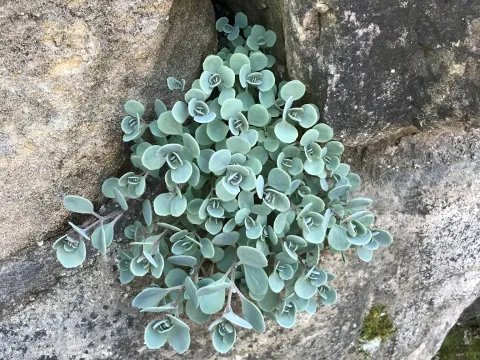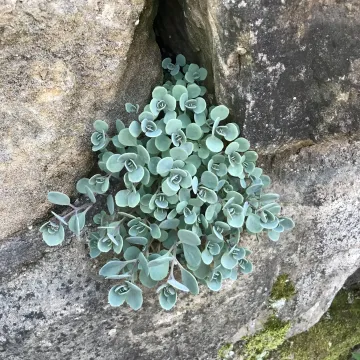

Cliff stonecrop
Hylotelephium cauticola (Praeger) H. Ohba
Description
Cliff stonecrop, scientifically classified as Hylotelephium cauticola, is a resilient perennial succulent belonging to the Crassulaceae family. This species is widely recognized in agriculture and landscaping for its ability to thrive in extreme environments where most traditional crops fail to survive.
Originating from the mountainous regions of East Asia, specifically Japan and Korea, this plant has adapted to rocky crevices and sparse, mineral-heavy soils. Its evolutionary history has made it a model organism for studies regarding plant resilience under conditions of extreme moisture fluctuation and low nutrient availability.
The botanical structure of the plant consists of thick, fleshy, glaucous leaves arranged along trailing stems. During the late summer to autumn months, the plant blooms with clusters of small, star-shaped flowers that range in color from soft pink to deep magenta, providing late-season nectar for local pollinators.
Agronomically, the plant requires a growing medium with excellent drainage. It thrives best in sandy or gravelly soils where water cannot accumulate near the root system. Providing direct, unobstructed sunlight is crucial for maintaining the plant's characteristic compact habit and preventing etiolation, which is the primary cause of structural weakness.
In terms of agricultural and landscape utility, cliff stonecrop is a staple in rock gardening and an emerging favorite for green roof installations. Its low maintenance requirements—such as minimal fertilization and very low water needs—make it an economically viable choice for large-scale landscaping projects. Disease resistance is generally high, though growers should be vigilant against root rot caused by poor soil drainage.
- Excellent drought tolerance once established.
- Preferential growth in neutral to slightly alkaline, rocky soils.
- High degree of hardiness against temperature fluctuations.
- Propagates easily via stem cuttings during the active growth phase.
Photo gallery