
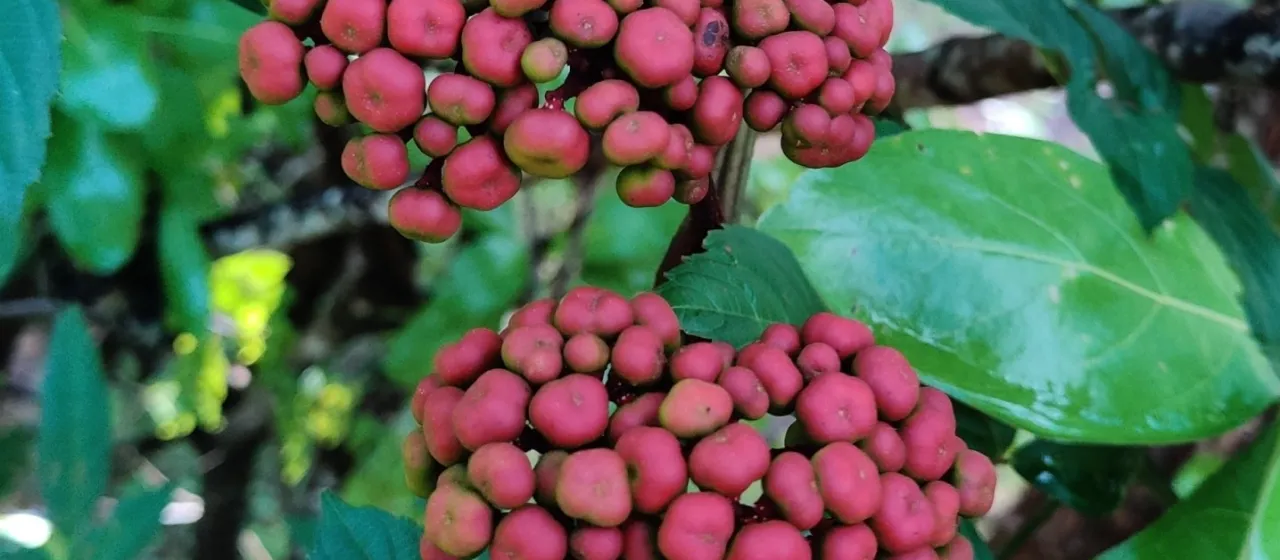
Description
Red Leea (Leea rubra) is a perennial evergreen plant that belongs to the Vitaceae family. While not a conventional agricultural crop for food production, it is a significant species in the ornamental plant industry, particularly in tropical and subtropical regions. The plant is prized for its lush, pinnate foliage and its striking reddish coloration, which provides high aesthetic value in landscape design.
The origin of Leea rubra is traced back to the humid tropical forests of Southeast Asia. It thrives naturally in the understory of dense forests, where the canopy provides shade and protects the foliage from direct, harsh sunlight. Its cultivation is concentrated in regions that support tropical climates, as the plant lacks frost tolerance and requires consistent, warm temperatures throughout the year.
Botanically, the plant is characterized by its woody stems and large, compound leaves that display a deep red or bronze tint when young. Its flowers are small but appear in large, attractive clusters, ranging from pink to deep red. This structural complexity makes it an excellent choice for ornamental gardening, providing texture and color contrast against purely green vegetation.
The cultivation requirements for Leea rubra involve well-draining, nutrient-rich soil that mimics the organic-heavy forest floor. Irrigation must be consistent, as the plant suffers from both drought and waterlogging. Providing partial shade is critical, as high solar radiation can bleach the leaves or cause dehydration. Fertilization with balanced nitrogen-rich compounds promotes healthy foliage expansion.
Regarding pest management, the plant is susceptible to common greenhouse pests such as spider mites, mealybugs, and scale insects. Regular inspection of the undersides of the leaves is advised. In terms of usage, the plant is primarily utilized in horticultural trade for interior design, conservatory planting, and landscaping in tropical zones, serving as a decorative feature rather than a harvestable commodity.