
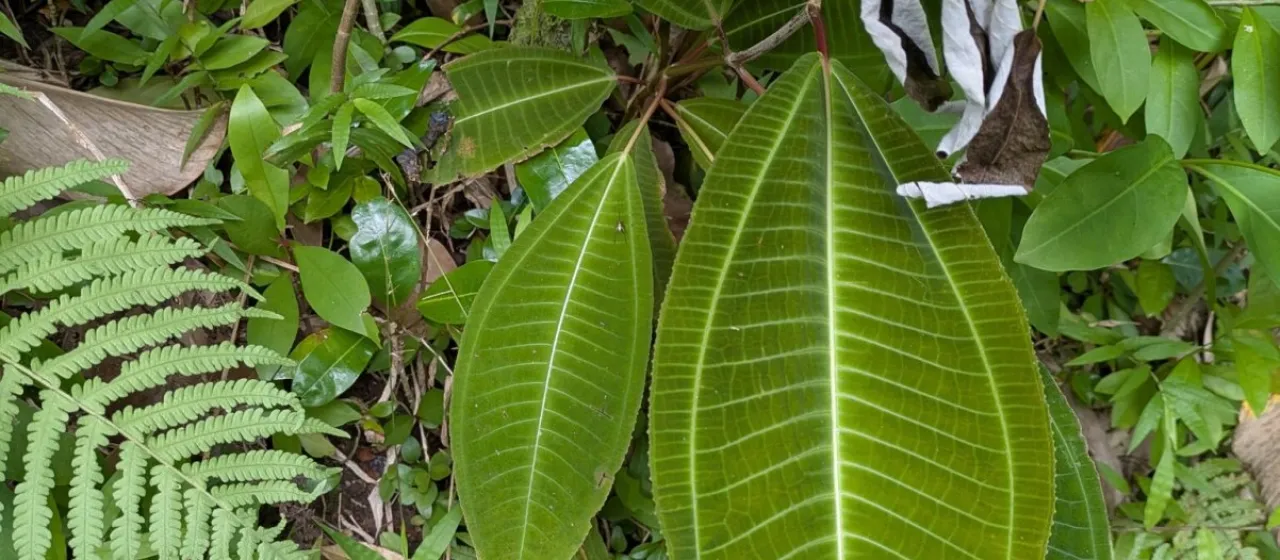
Description
Miconia calvescens, commonly known as the velvet tree or purple plague, belongs to the Melastomataceae family. While historically introduced to various regions as a stunning ornamental plant due to its dramatic foliage, it has since become one of the most destructive invasive species in tropical and subtropical island ecosystems worldwide.
The species is native to the rainforests of Mexico, Central America, and South America. Its rapid spread is primarily due to human activity, as it was transported for greenhouse and garden cultivation. Once established outside its native range, it quickly outcompetes endemic species, leading to massive disruptions in forest structure and loss of local biodiversity.
The botanical profile of Miconia is defined by its massive, dark green leaves with striking purple undersides and prominent, sunken veins. The plant develops large, conical panicles of small, hermaphroditic flowers, which produce billions of seeds annually through berry-like fruits. These fruits are highly attractive to birds, facilitating long-distance dispersal and rapid colonization of diverse habitats.
Ecologically, Miconia thrives in high-humidity environments with stable, warm temperatures. It is highly shade-tolerant, allowing it to grow beneath the canopy of established forests, eventually surpassing native trees in height. It prefers deep, nutrient-rich soils but shows remarkable resilience across varying soil types, making it nearly impossible to eradicate once it takes root in a suitable area.
- Height potential of 15+ meters.
- Ability to produce millions of viable seeds per year.
- High tolerance for low-light forest floor conditions.
- Aggressive root system contributing to soil erosion on steep slopes.
From an agricultural management perspective, Miconia is not considered a productive crop but rather a high-priority pest. Control measures focus on systematic manual removal of saplings, herbicide application on larger trees, and rigorous quarantine protocols to prevent further spread. Ongoing research is investigating potential biological control agents to curb its expansion without damaging native vegetation.