
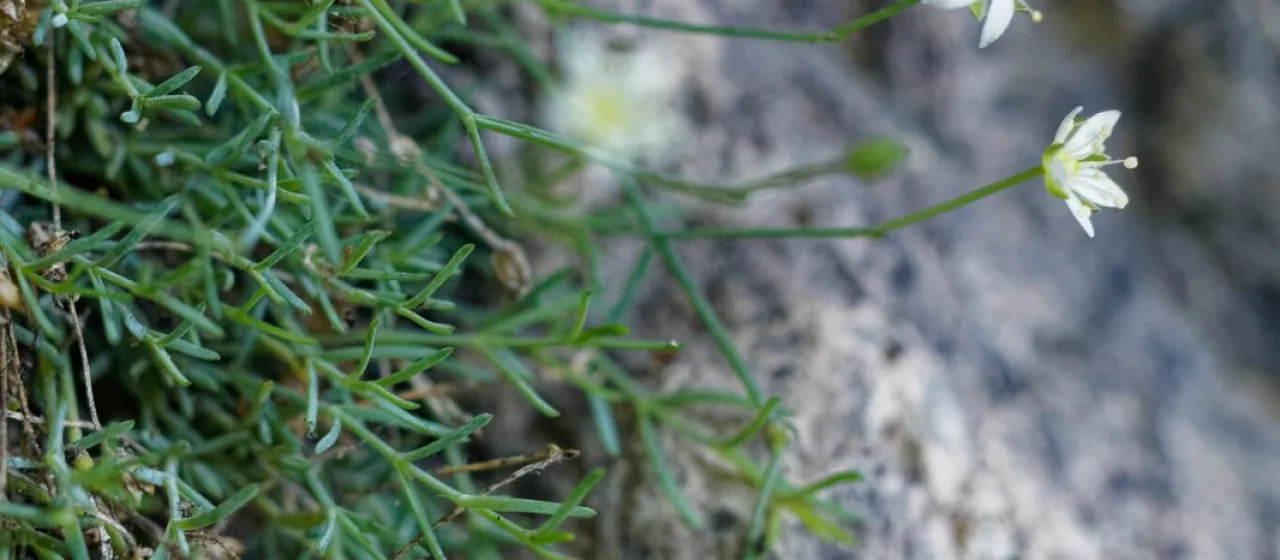
Description
Moehringia glaucovirens is a herbaceous perennial species that belongs to the Caryophyllaceae family. Known for its specific adaptation to mountainous environments, this plant is characterized by a compact growth habit and a unique appearance that distinguishes it within the diverse family of carnations.
The plant originates from the high-altitude regions of Southeastern Europe. In its natural habitat, it thrives in rocky crevices, scree slopes, and stony soils. This distribution highlights the plant's ability to withstand nutrient-poor substrates and direct exposure to intense mountain sunlight.
Botanically, it is defined by its forming dense, mat-like patches. The leaves exhibit a distinctive glaucous-green coloration, providing an aesthetic appeal. The small, white flowers emerge during the blooming season, sitting atop short stems, which allows the plant to survive in areas with high wind speeds and harsh temperature fluctuations.
Agricultural requirements for this species are specific and centered on mimicking its natural alpine environment. Successful cultivation requires a mineral-based, well-drained substrate with a neutral to alkaline pH. Gardeners must avoid heavy, water-retentive soils, as the root system is highly susceptible to rot under conditions of excessive moisture.
While Moehringia glaucovirens is not a mainstream agricultural crop, it is of great value in ornamental horticulture, particularly in rock gardening. It serves as an excellent candidate for alpine-themed landscapes. Maintenance primarily involves ensuring good drainage and protection from aggressive competitive weeds that might overshadow the small plant.
- Family: Caryophyllaceae.
- Growth habit: Low-growing, mat-forming perennial.
- Soil preference: Gritty, fast-draining, and nutrient-poor.
- Pest management: Generally resistant, though prone to fungal pathogens in high humidity.