Phoradendron californicum
Phoradendron californicum
Description
Phoradendron californicum, commonly known as desert mistletoe, is a perennial hemiparasitic plant belonging to the Santalaceae family. Unlike conventional agricultural crops, this species is a specialist parasite that survives by tapping into the vascular systems of host trees, extracting water and essential minerals through specialized structures known as haustoria.
The plant is native to the arid desert regions of the southwestern United States and northwestern Mexico. It is specifically adapted to environments characterized by intense solar radiation, extreme temperature fluctuations, and periodic drought. Its distribution is strictly limited by the presence of suitable host tree species, most notably various types of Prosopis and Acacia.
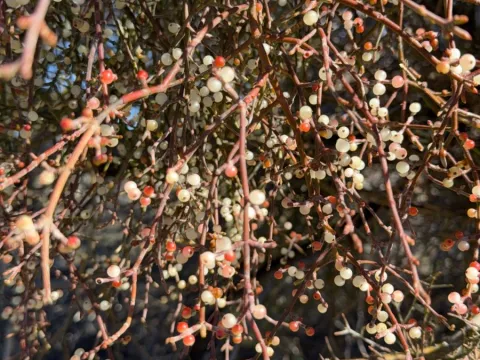
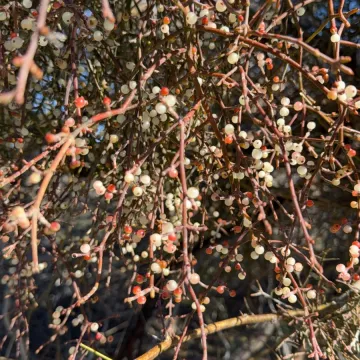
Botanically, it is a densely branched shrub with reduced, scale-like leaves. This reduction in foliage surface area is a key evolutionary strategy to prevent excessive water loss in the desert heat. The plant performs photosynthesis, but relies heavily on the host for hydration, making it a hemiparasite. Its small, translucent red or pinkish berries are a critical energy source for desert avian populations.
From an agricultural management perspective, Phoradendron californicum can be detrimental when it infects ornamental or plantation trees. While it is rarely "cultivated," arborists and land managers must implement control measures such as pruning infected branches to prevent the parasite from siphoning too many resources from the host, which could otherwise lead to premature tree decline.
There are no pests or diseases that typically threaten this plant, as it occupies a parasitic niche that is already highly protected by the host's defenses. Instead, it is the host tree itself that suffers from the presence of the mistletoe. Its management remains focused on maintaining the balance between ecological support for local birds and the health of the desert forestry projects.
- Family: Santalaceae
- Plant type: Stem hemiparasite
- Key adaptation: Scale-like leaves for water conservation
- Reproduction: Seed dispersal by birds
- Typical environment: Sonoran and Mojave Desert shrublands
Photo gallery