Phoradendron randiae
Phoradendron randiae
Description
Phoradendron randiae is a woody hemi-parasitic plant belonging to the Santalaceae family. Previously associated with the Viscaceae family, current taxonomic studies place this genus within the larger sandalwood order. This plant is a specialized organism that derives its sustenance by attaching itself to the branches of host trees, primarily within specific subtropical environments.
The native range of this species is predominantly found in Mexico and other parts of Central America. Unlike traditional crops, Phoradendron randiae is not cultivated for agricultural or commercial purposes. Instead, it occupies a specific ecological niche as a hemiparasite, meaning it retains chlorophyll and conducts photosynthesis while simultaneously tapping into the host tree's xylem for water and minerals.
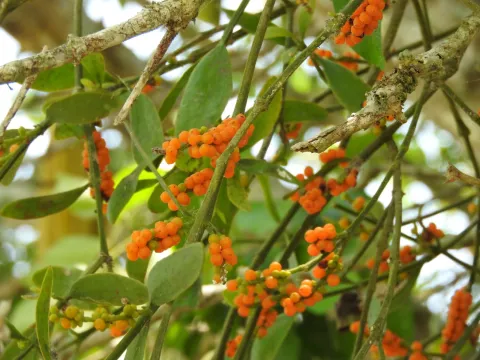
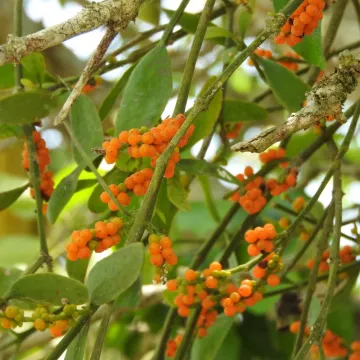
Botanically, it is identified as an evergreen shrub characterized by opposite leaves and succulent berries. A key feature is the presence of haustoria, which are root-like structures modified for penetrating the host's tissues. These structures allow for the efficient extraction of nutrients and stable attachment, which is vital for the plant's survival throughout its lifecycle.
Climate requirements for this species are closely tied to the survival of its host tree. It thrives in regions with stable tropical or subtropical humidity levels. There are no standard agricultural practices for this plant, as it is strictly a wild species. Its propagation is entirely reliant on ornithochory, where birds feed on the sticky fruit and transfer the seeds to the bark of new trees, facilitating colonization.
The economic impact of this species is generally perceived as negative in forestry and silviculture, as heavy infestations can weaken host trees and affect their long-term health. However, the species is of significant interest to botanists studying the evolution and physiological mechanisms of parasitic plants. Conservation efforts focus on protecting the natural ecosystems where this biodiversity is found, rather than managing the plant as a crop.
Photo gallery