White poplar
Populus alba x Populus tremula var. glandulosa
Description
White poplar (lat. Populus alba) is a fast-growing deciduous tree belonging to the Salicaceae family. It is highly valued in commercial forestry and landscape management for its rapid biomass production and high environmental adaptability.
The native range of this species extends across Europe, Central Asia, and North Africa. It is traditionally found in riverine habitats and floodplains, thriving in moist, deep soils. These historical growing conditions dictate its preference for high water tables and nutrient-rich environments.
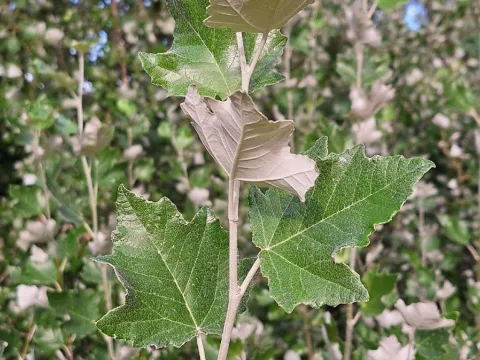
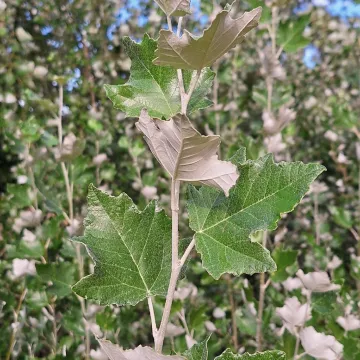
Botanically, the white poplar is distinguished by its lobed leaves with a striking white, woolly underside and a smooth, whitish-gray bark on young stems. The tree is capable of reaching significant heights, forming a broad, spreading crown that is effective for carbon sequestration and wind protection.
Regarding agrotechnics, the white poplar requires full sun and consistent moisture. Propagation is typically achieved through hardwood cuttings or root suckers. When establishing plantations, spacing must be carefully managed to prevent competition, as the tree exhibits vigorous growth and requires significant lateral space.
- Excellent tolerance to temporary flooding.
- High biomass yield for industrial applications.
- Valuable for soil erosion control in riverbanks.
- Ease of propagation and fast establishment.
Common issues include fungal rusts and various types of leaf blight. Pests such as aphids or stem borers can impact timber quality. Effective management involves maintaining tree health through thinning and regular inspections, ensuring that the plantation remains vigorous and resistant to potential infestations.
Photo gallery