White dead-nettle
Lamium album L.
Description
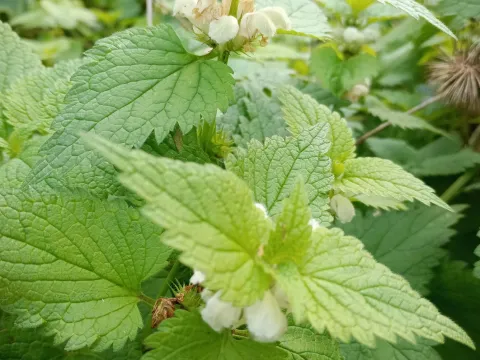
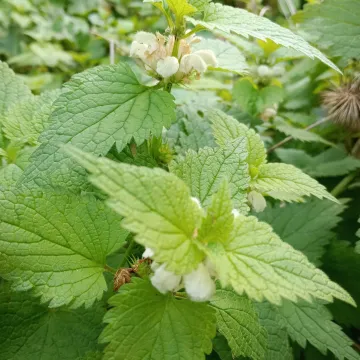
White dead-nettle (Lamium album L.) is a perennial herbaceous plant belonging to the mint family (Lamiaceae). It is famously known as dead-nettle due to its remarkable resemblance to stinging nettle, yet it completely lacks stinging hairs, making it harmless to handle.
This species is native to most of Europe and temperate Asia. It is a common inhabitant of roadsides, hedge banks, woodland edges, and cultivated gardens. Its ability to colonize various habitats demonstrates its high environmental resilience and adaptability to different light and soil conditions.
Botanically, it features a square stem, opposite heart-shaped leaves, and whorls of white, bilabiate flowers located in the leaf axils. The plant spreads through a creeping rhizome system, which allows it to establish extensive colonies in favorable environments.
Regarding cultivation, white dead-nettle thrives in fertile, moist, and well-drained soils. While it is highly shade-tolerant, it grows most vigorously in semi-shaded spots. It is notably frost-hardy and requires minimal maintenance, though in garden settings, it may require control measures to prevent unwanted spreading.
Economically, it serves as an excellent source of nectar for early-season pollinators, particularly bees. In herbal medicine, the flowers and leaves are utilized for their astringent and anti-inflammatory properties. Typical pests include leaf-feeding beetles, while fungal issues like powdery mildew may occur in damp, poorly ventilated areas.
Photo gallery