


SKU #26639
·
36 views
Split
Fungicides
Agrochemical, LLCUser rating
0 votes0% positive reviews
No ratings yet — be the first.
Type of Action
Systemic fungicide, Contact fungicide
Form of the preparation
Water Emulsion
Danger Class
3
Drug Consumption
0.15-0.2
About product
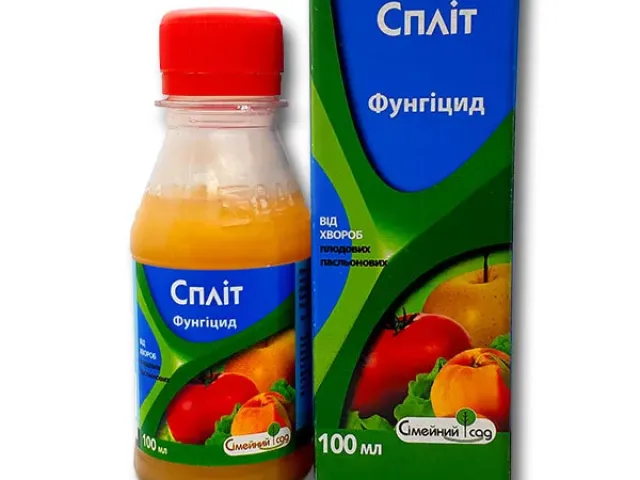
A systemic fungicide featuring Difenoconazole for professional, broad-spectrum control of scab and powdery mildew in apple orchards.
Type of Action
Systemic fungicide, Contact fungicide
Form of the preparation
Water Emulsion
Danger Class
3
Drug Consumption
0.15-0.2
Description
Engineering Precision in Orchard Protection
The «Split» fungicide leverages the chemical properties of Difenoconazole, a triazole-class systemic active ingredient that has become a standard in fruit crop protection. The technical advantage of this formulation lies in its dual-action mechanism: systemic movement within the plant vascular system combined with strong contact activity on the plant surface. By inhibiting the biosynthesis of ergosterol, the active substance effectively halts the growth of fungal mycelium and prevents spore formation.
Key Technical Features
The aqueous emulsion formulation is designed to ensure maximum bioavailability and stability in the tank mix. This is crucial for uniform coverage of the apple tree's waxy cuticle, preventing runoff and increasing the therapeutic window. The product's technical efficiency is defined by:
- Acropetal Translocation: The systemic component moves upwards through the plant, shielding new growth that emerges post-application.
- Localized Contact Shield: The contact component provides an immediate protective barrier that stops pathogens upon physical contact.
- Optimal Dosage Control: With a recommended rate of 0.15–0.2 L/ha, growers can tailor the application based on disease pressure and phenological stage.
Operational Guidelines for Professionals
«Split» is engineered for consistent results within a robust integrated pest management (IPM) program. Allowing for up to 4 applications per season, it provides a comprehensive defense strategy against scab and powdery mildew. From a safety and regulatory perspective, the 20-day pre-harvest interval (PHI) is critical to ensure that the active ingredient is fully metabolized by the time of harvest, resulting in clean, high-quality produce. Classified under hazard class 3, the product requires standard agricultural handling procedures to maximize efficiency and minimize environmental footprint.
Composition
Active ingredients
- Difenoconazole фунгицид Триазолы
Application
Used on crops
Against diseases
Specifications hover over for a hint about the specification
|
Type of Action
Type of Action
Insecticides are divided into contact, systemic, stomach, and fumigants based on their mode of entry into the organism. Contact insecticides affect insects upon contact with any part of their body, penetrating into their organism through the integument. They are used against pest... |
|
|---|---|
| Form of the preparation | |
| Danger Class | 3 |
|
Drug Consumption
Drug Consumption
Mass of the preparation per unit of treated area. It is customary to express the dosage rate in kilograms per hectare. The dosage rate is most often given in terms of 100% active ingredient, although sometimes it is calculated based on the preparation in the form of application w... |
0.15-0.2 |
|
Maximum number of treatments
Maximum number of treatments
Maximum recommended number of treatments per vegetation period. |
4 |
|
Last Processing Date, Days
Last Processing Date, Days
Number of days from processing to harvest cleanup |
20 |
| Catalog | Catalog → Fungicides |
| Manufacturer | Agrochemical, LLC |
| Manufacturer | China National Complete Engineering Corporation |
| Manufacturer | Hangzhou Ruijiang Chemical Co., Ltd. |
| Manufacturer | Zhejiang Dayo Chemical Industrial |
| Manufacturer | Agricopter Asia Limited |
| Applicant | Vassma-Chemical, LLC |
| Country | China |
Store offers · 2 from 2 stores
Prices are updated on loadLoading offers…
Aggregator catalog: prices are collected automatically from store websites, normalized by AI and converted at the current exchange rate. Before ordering, confirm the price and availability on the store's website. This block is not indexed by search engines — the data is loaded after the page opens.
Alternatives
Apple · similar varieties


See also
Often considered together with this variety


Recently viewed
Similar items in this catalog section


TMTD
ЗАТ Фірма Август, Росія.,селище Вурнари,
From your browsing history
06.3K 11 offers
3.6 €за 1 л ≈ 184 ₴


Comments · 0