


SKU #3754
·
478 views
Triumph Pakgama
Pear
User rating
0 votes0% positive reviews
No ratings yet — be the first.
Type of Sort
Autumn variety of pear
About product

Autumn variety developed by S. Pakgama (Australia) in 1897. It was registered in the North Caucasus region. In Europe, it is currently one of the main commercial varieties.
Tree is weak-growing, with a broad-pyramidal, asymmetric, somewhat sparse crown. Main branches diverge from the trunk at an angle of 35-40°. Bark on the trunk and scaffold branches is gray. Fruit-bearing mainly occurs on b…
Type of Sort
Autumn variety of pear
Description
Autumn variety developed by S. Pakgama (Australia) in 1897. It was registered in the North Caucasus region. In Europe, it is currently one of the main commercial varieties.
Tree is weak-growing, with a broad-pyramidal, asymmetric, somewhat sparse crown. Main branches diverge from the trunk at an angle of 35-40°. Bark on the trunk and scaffold branches is gray. Fruit-bearing mainly occurs on buds on 2-3-year-old wood.
Medium-length shoots, curved, nearly straight, greenish-brown in color, turning brown with a slight reddish tint upon maturation. Buds are small, elongated, light-brown, with good leafiness. Shoot-forming ability is weak. Branches are densely covered with buds. Leaves are medium-sized, elongated-ovate. Leaf blade is slightly curved upward along the main vein, with a slightly drooping tip. Leaf margins are finely serrated. Petiole is short. Buds are densely arranged, small, pressed, conical, hairless, brown in color.
Flowering is early.
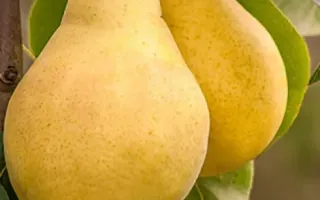
Fruits are medium to above-average size (mass 150 g), pear-shaped with a warty surface. Skin is of medium thickness; during harvest maturity, it is greenish-yellow, and in consumer maturity, it is light-yellow with rusty spots and speckles.
Flesh is white, tender, melting, juicy, slightly acidic-sweet, with a mild nutmeg aroma, very good in flavor. Chemical composition of the fruit: sugars — 9.1%, titratable acids — 0.35%, dry matter — 15.1%, ascorbic acid — 5.3 mg/100g, P-active catechins — 59.2 mg/100g of dry matter.
Harvest maturity of fruits occurs in the second half of September, consumer maturity — in November-December. Fruits remain firmly attached to the tree.
Enters fruiting stage 3-4 years after planting in the orchard. Bears fruit abundantly and relatively regularly. Variety is not sufficiently winter-hardy. Highly susceptible to scab.
Advantages of the variety: weak growth, early fruiting, and high yield of trees, excellent fruit flavor.
Disadvantages of the variety: susceptibility to scab.
Video · 4 videos
Suggest a video →Crop & resistance
Crop
Specifications
| Type of Sort | |
|---|---|
| Catalog | Catalog → Pear |
Store offers · 3 from 3 stores
Prices are updated on loadLoading offers…
Aggregator catalog: prices are collected automatically from store websites, normalized by AI and converted at the current exchange rate. Before ordering, confirm the price and availability on the store's website. This block is not indexed by search engines — the data is loaded after the page opens.
Alternatives
Common pear · similar varieties




See also
Often considered together with this variety


Recently viewed
Similar items in this catalog section


Comments · 0