
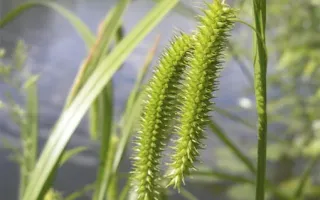


SKU #74677
·
54 views
Kazorovichskaya / Kozarovitska
Timofeyevka
User rating
0 votes0% positive reviews
No ratings yet — be the first.
Usage Type
On feed
Green Mass Yield (t/ha)
30-45
Crude Protein Content, %
15-19
About product

Kazorovichskaya is a perennial timothy grass derived from the combination of varieties Kazorovichskaya, Sarnenskaya 35, Brdutsuykaya and Moskovskaya 1480, as well as a wild specimen from the Yaroslavl region. The plant is characterized by an erect bush with a height of 70–80 cm, loosely branched structure and two-ranked arrangement. Leaves are 15–23 cm long with an acute ligula, the inflorescence…
Usage Type
On feed
Green Mass Yield (t/ha)
30-45
Crude Protein Content, %
15-19
Description
Kazorovichskaya is a perennial timothy grass derived from the combination of varieties Kazorovichskaya, Sarnenskaya 35, Brdutsuykaya and Moskovskaya 1480, as well as a wild specimen from the Yaroslavl region. The plant is characterized by an erect bush with a height of 70–80 cm, loosely branched structure and two-ranked arrangement. Leaves are 15–23 cm long with an acute ligula, the inflorescence is cylindrical gray in color, spikelets are greenish‑yellow, seeds are light‑gray measuring 0.8–1.2 mm. The yield of green mass reaches 44 t/ha, dry matter – 8.0 t/ha, and seeds – 0.5 t/ha. The content of crude protein is 15–16 %, fiber – not more than 25–28 %. The plant is well eaten by cattle and suitable for afforestation of floodplains, improving hayfields and pastures.
Kazorovichskaya differs in good winter hardiness and the ability to withstand flooding with melt water up to 30–35 days. With intensive nitrogen fertilization, the yield of dry matter can increase by 2–10 times, reaching 93–109 c/ha at a dose of N240. Research results show high productivity and resistance of this variety on lowland meadows of the right-bank Polissya in Ukraine, which makes it one of the most promising types for intensive hayfield production.
For cultivation, it is recommended to sow in pure form or under a cover of spring cereals in early spring. The row spacing is 30 cm, density – 16 million viable plants per ha, seeding rate – 8 kg/ha, sowing depth – 0.5–0.7 cm. The variety has been approved for use in the Russian Federation and meets the requirements of GOST; however, its application has also been successfully implemented in Ukraine, where it is part of mixtures of perennial cereal grasses for creating intensive-type hayfields on areas exceeding 46 thousand hectares.
Kazorovichskaya differs in good winter hardiness and the ability to withstand flooding with melt water up to 30–35 days. With intensive nitrogen fertilization, the yield of dry matter can increase by 2–10 times, reaching 93–109 c/ha at a dose of N240. Research results show high productivity and resistance of this variety on lowland meadows of the right-bank Polissya in Ukraine, which makes it one of the most promising types for intensive hayfield production.
For cultivation, it is recommended to sow in pure form or under a cover of spring cereals in early spring. The row spacing is 30 cm, density – 16 million viable plants per ha, seeding rate – 8 kg/ha, sowing depth – 0.5–0.7 cm. The variety has been approved for use in the Russian Federation and meets the requirements of GOST; however, its application has also been successfully implemented in Ukraine, where it is part of mixtures of perennial cereal grasses for creating intensive-type hayfields on areas exceeding 46 thousand hectares.
Specifications
| Usage Type | |
|---|---|
| Green Mass Yield (t/ha) | 30-45 |
| Crude Protein Content, % | 15-19 |
| Catalog | Catalog → Timofeyevka |
| Originator | Kyivs'ka DS NNC «Institute of Agriculture UA» |
| Country | Ukraine |
Store offers
Prices are updated on loadLoading offers…
Aggregator catalog: prices are collected automatically from store websites, normalized by AI and converted at the current exchange rate. Before ordering, confirm the price and availability on the store's website. This block is not indexed by search engines — the data is loaded after the page opens.
See also
Often considered together with this variety





Recently viewed
Similar items in this catalog section




Comments · 0