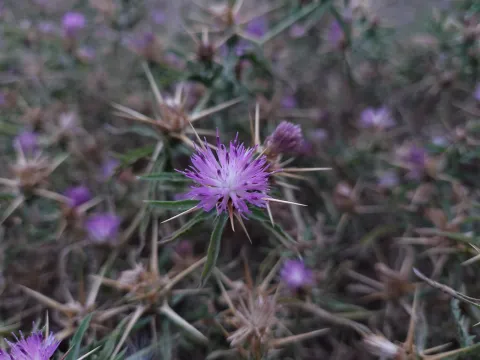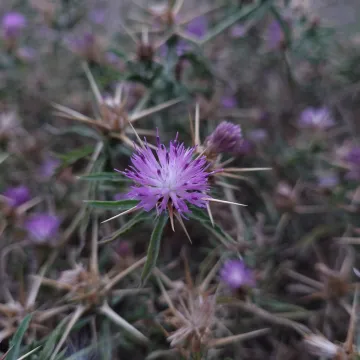
Purple starthistle
Centaurea calcitrapa L.
Description
Purple starthistle (Centaurea calcitrapa L.) is a herbaceous plant belonging to the Asteraceae family. Known for its aggressive growth, it is classified as a significant weed in various agricultural sectors, particularly in rangelands and cropping systems, where it poses a threat to biodiversity and agricultural productivity.
Native to the Mediterranean region and parts of Western Asia, this plant has spread extensively across various continents, including North America and Australia. Its range is primarily defined by Mediterranean-type climates, though it has proven capable of adapting to a variety of environmental conditions, including degraded soils and dry habitats.
Botanically, the plant is characterized by a branched stem and prickly, rigid bracts surrounding its flower heads. The leaves are deeply lobed and often covered in fine, white hairs. The root system is deep and taproot-like, allowing the plant to compete effectively for groundwater and nutrients, even in arid conditions that limit the growth of desired crops.
Regarding cultivation requirements, the plant is not a commercial crop but rather a resilient survivor. It thrives in open, sunny sites and is well-adapted to poor-quality soils where competition from other vegetation is low. Its presence in agricultural fields often indicates soil disturbance or improper land management, necessitating a change in local agronomic practices.
As a non-crop species, its management is strictly focused on control and eradication. Key agricultural practices include:
- Timely mechanical removal before seed set to prevent spread.
- Targeted chemical control using herbicides in infested fields.
- Improving pasture health through competitive sowing of native grasses.
- Strict monitoring of irrigation systems and equipment to avoid seed dispersal.
In terms of pathology, the plant is remarkably hardy, showing little susceptibility to common crop pests or diseases. Its defensive mechanisms, particularly the sharp spines, effectively deter herbivores, which contributes to its status as a persistent invasive weed in non-cultivated areas and neglected farmlands.
Photo gallery