Dusty miller
Centaurea cineraria L.
Description
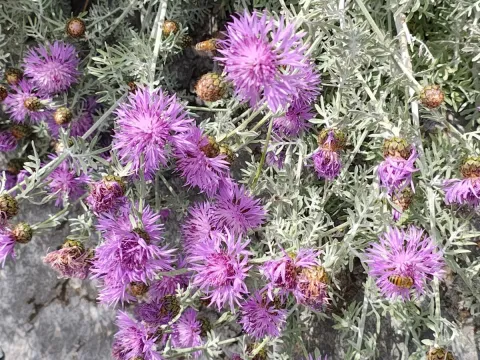
Dusty miller (Latin: Centaurea cineraria) is an ornamental perennial plant belonging to the Asteraceae family. It is widely recognized in professional landscaping for its distinctive, deeply lobed, silvery-grey foliage, which provides a striking visual contrast to vibrant flowering species in garden borders.
Native to the Mediterranean region, this species naturally inhabits rocky cliffs and sunny, coastal environments. Its evolutionary history has made it highly adaptable to arid conditions, allowing it to thrive in nutrient-poor, well-drained soils where other more demanding plant species might struggle to survive.
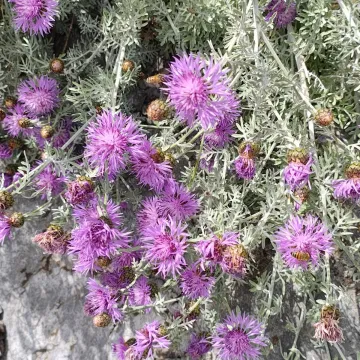
Botanically, the plant forms a low-growing mound reaching heights of 30 to 50 centimeters. Its unique silvery appearance is due to a dense layer of fine white hairs covering the leaf surface, which acts as a protective mechanism against intense sunlight and dehydration. During the summer, it produces small purple or magenta flowers, although the foliage remains its primary ornamental feature.
Cultivation requirements involve high solar exposure and excellent drainage. It is essential to avoid heavy, water-logged soils, as moisture retention in the crown often leads to fungal decay. In temperate climates, this plant is frequently treated as an annual or biennial because it lacks significant cold hardiness compared to more robust perennial varieties.
In terms of plant health, Dusty miller is relatively resistant to pests, but it can be susceptible to aphids and spider mites during periods of high humidity or poor ventilation. Implementing proper spacing is the most effective management strategy to maintain airflow and prevent diseases such as downy mildew or root rot in landscape plantings.
Photo gallery