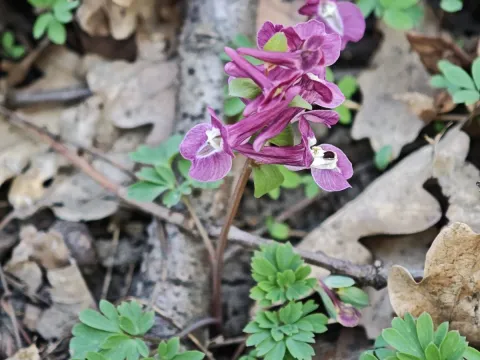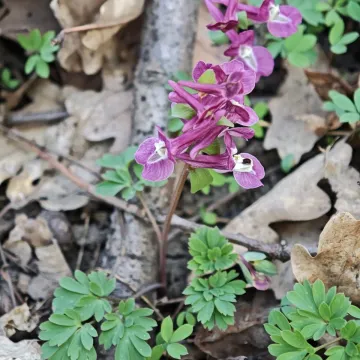
Caucasian corydalis
Corydalis caucasica
Description
Caucasian corydalis (Corydalis caucasica) is a perennial herbaceous plant belonging to the Papaveraceae (Poppy) family. It is recognized as a spring ephemeral, completing its vegetative cycle rapidly during the early spring season before forest canopies become dense.
The native habitat of this plant is restricted to the Caucasus region, primarily found in deciduous forest zones and subalpine meadows. Its ecological niche is characterized by rich, humus-containing soils and moist, shaded environments, which dictates its preferences in garden settings.
Botanically, this species is defined by its subterranean tuber, which serves as a nutrient storage organ. It reaches heights of 20–30 cm, featuring delicate, glaucous foliage and racemes of spurred flowers that provide a vibrant display in shades ranging from pink to deep violet-purple.
Cultivation requirements involve providing well-drained, nutrient-rich soil that mimics a woodland floor. The plant thrives in partial shade and is particularly sensitive to soil moisture levels during its active spring growth phase; thus, consistent irrigation is recommended during dry springs.
In terms of agricultural and horticultural use, the Caucasian corydalis is solely utilized as an ornamental plant. It is a preferred choice for rock gardens, shaded borders, and naturalistic woodland plantings. Due to its early growth, it effectively competes for space before summer-blooming perennials emerge.
- Requires light, organic-rich soil media.
- Must be protected from full midday summer sun.
- Dormancy occurs in late spring to early summer.
- Minimal fertilization needed if soil is high in humus.
- Good pest resistance due to natural alkaloid content.
Photo gallery