Ground cedar
Diphasiastrum complanatum
Description
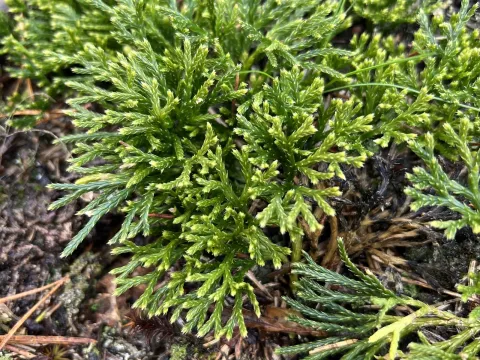
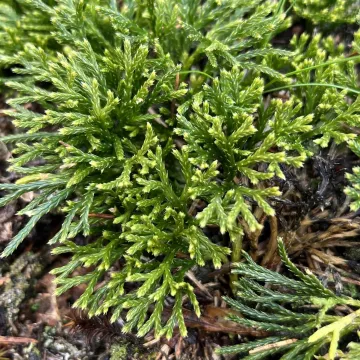
Ground cedar (Latin: Diphasiastrum complanatum) is a perennial creeping vascular plant belonging to the Lycopodiaceae family. It is a distinctive evergreen species characterized by flattened, fan-like branches that resemble coniferous foliage. Although often confused with mosses, it is a complex spore-bearing plant with a primitive but highly efficient vascular system.
The natural range of this species encompasses the temperate and boreal regions of the Northern Hemisphere, including large parts of North America, Europe, and Asia. It typically thrives in open coniferous or mixed forests, often establishing itself on sandy, acidic, and nutrient-poor soils. The plant requires cool, humid conditions and thrives in areas with consistent moisture levels.
Botanically, the plant features long, subterranean rhizomes from which aerial stems emerge. The leaves are small, scale-like, and appressed to the stem, giving the branches their signature flattened appearance. Reproduction is primarily achieved through spores produced in strobili, which appear on elongated peduncles during the late summer months. Vegetative expansion through rhizomes also plays a crucial role in colony growth.
From an agronomic and horticultural perspective, Ground cedar is not a conventional crop. It is notoriously difficult to cultivate because of its slow growth rate and strict requirement for specific mycorrhizal fungi associations. These symbiotic relationships are essential for nutrient uptake; without them, the plant fails to thrive or even germinate. Consequently, it remains a strictly wild species unsuitable for standard agricultural practices.
The plant has been historically used in traditional medicine and industrial casting, where its spores were utilized as a dusting agent due to their hydrophobic properties. Today, however, its use is strictly limited due to its protected status and the presence of toxic alkaloids. It serves primarily as an important ecological indicator of forest health, and conservation efforts are focused on protecting its habitat from forestry and human disturbance.
- Family: Lycopodiaceae
- Life cycle: Perennial, spore-bearing
- Habitat: Coniferous forests and sandy barrens
- Key characteristic: Flattened, fan-shaped branches
Photo gallery