Madeiran clubmoss
Diphasiastrum madeirense
Description
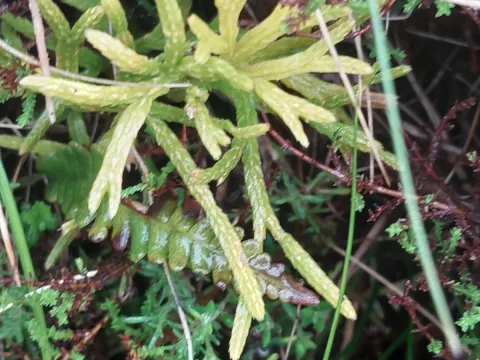
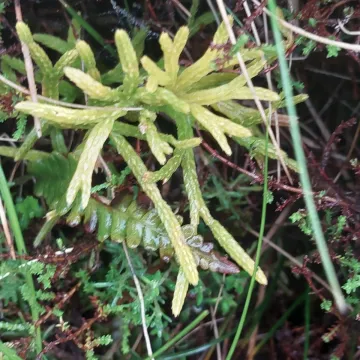
Madeiran clubmoss (Diphasiastrum madeirense) is a distinctive species of vascular spore-bearing plant belonging to the Lycopodiaceae family. It is a perennial evergreen plant recognized by its creeping stems and specific branching patterns that distinguish it within the clubmoss group.
The plant is a strict endemic to the island of Madeira, Portugal. It thrives in high-altitude habitats, specifically within the cloud forest zones or mountain heaths where the climate is consistently cool and humid. These regions provide the essential atmospheric moisture required for its survival.
Botanically, the species features horizontal stems that root into the substrate, with vertical shoots that display flattened, scale-like leaves. Its reproductive organs, known as strobili, are borne on terminal branches. The life cycle involves a complex alternation of generations, which is typical for all members of the order Lycopodiales.
Regarding its ecological requirements, the species is highly specialized. It requires acidic, nutrient-poor, yet moist soils and thrives in association with specific mycorrhizal fungi. Due to its slow growth rate and sensitivity to environmental changes, it is not cultivated for agricultural purposes.
The primary significance of this plant lies in biodiversity conservation and botanical research. As an endemic species, it serves as a key indicator of the unique flora of the Macaronesian region. It is not currently considered a crop, and conservation efforts are focused on protecting its fragile native habitat from degradation.
- Endemic status to the Madeira archipelago.
- Dependence on mycorrhizal symbiotic associations.
- Sensitive to humidity and temperature fluctuations.
- Conservation-dependent species.
Photo gallery