Purple spike-rush
Eleocharis atropurpurea
Description
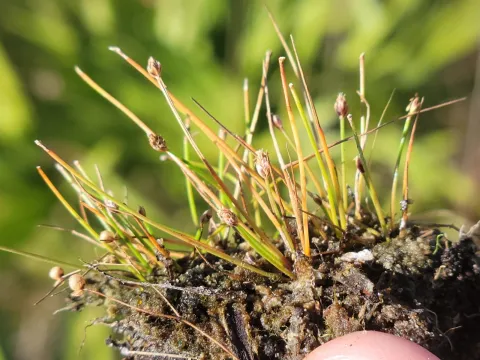
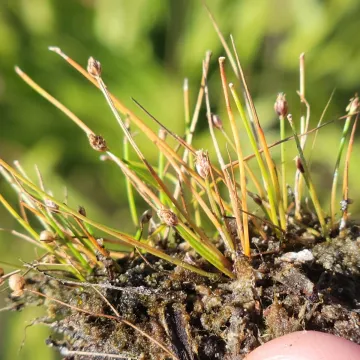
Purple spike-rush (Eleocharis atropurpurea) is a member of the Cyperaceae family, often recognized as a small, annual herbaceous plant. It is primarily found in wetland habitats, which makes it a unique object of study within the framework of aquatic and semi-aquatic agriculture. The plant is distinct due to its characteristic dark-colored spikes that emerge from the top of thin, leafless stems.
The origin of this species is global, with a broad distribution spanning across tropical, subtropical, and temperate zones of both the Old and New Worlds. In terms of agronomic geography, it is most frequently observed in rice-growing regions and areas adjacent to permanent irrigation infrastructure, where it can act as a natural component of the riparian ecosystem.
Botanically, the species is defined by its compact size, usually ranging from a few centimeters to about twenty in height. The stems are photosynthetic and circular in cross-section. The root system is relatively shallow, which is consistent with its preference for moist, silty substrates that do not require deep soil penetration for nutrient uptake. It produces seeds that are capable of long-term viability in submerged conditions.
Agronomic requirements are centered on water management. The plant demands high soil moisture content, specifically preferring saturated or inundated soils. It does not possess drought-tolerant mechanisms, so irrigation control is the primary factor in its maintenance. It thrives in warm climates, responding well to high solar radiation, provided the moisture levels remain stable throughout the growing season.
Potential agricultural applications are centered on environmental management. This includes the use of the plant in constructed wetlands for agricultural runoff purification and bio-filtration of nutrient-rich water. Furthermore, its role as a stabilizer for the soil edges of irrigation canals provides a protective function against erosion. Despite its niche utility, farmers should be aware of potential weed competition, as it can colonize irrigated fields if left unchecked.
The species is generally resistant to many common field pests due to its specific wetland habitat. However, high-density growth can lead to the spread of fungal pathogens if water circulation is insufficient. Integrated pest management in areas surrounding its cultivation should prioritize maintaining water flow and plant spacing to reduce the risk of secondary infections.
Photo gallery