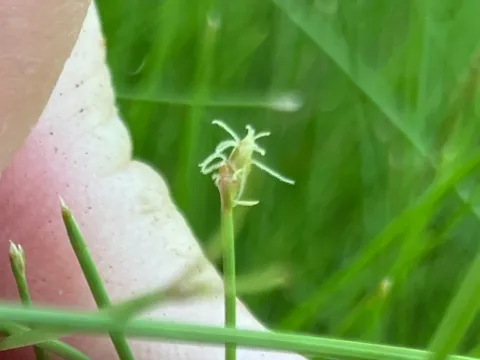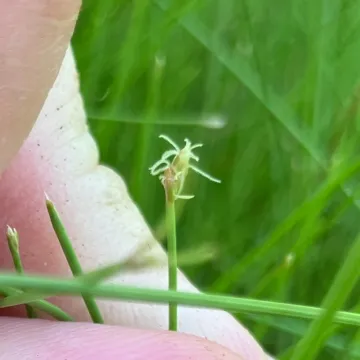

Baldwin's spikerush
Eleocharis baldwinii
Description
Baldwin's spikerush (Eleocharis baldwinii) is a perennial herbaceous plant belonging to the Cyperaceae family. Often referred to in landscaping as a versatile groundcover for damp areas, it is valued for its delicate, grass-like appearance and its ability to create dense, vibrant green carpets in suitable environments.
The species originates from North America, primarily found in the southeastern United States. It naturally thrives in wetland habitats, including riverbanks, shallow pond margins, and saturated soils. Its historical and current distribution is restricted to regions where environmental conditions mimic its native humid and marshy ecosystems.
Botanically, it is characterized by fine, hair-like stems that emerge from a creeping rhizome system. These stems typically reach heights of a few centimeters to about 15 centimeters. Its growth habit is stoloniferous, meaning it spreads horizontally across the surface, which makes it highly effective for erosion control and aesthetic covering of aquatic floors.
Cultivation of Eleocharis baldwinii requires careful attention to hydration and light levels. It performs best in nutrient-rich, fine-grained substrates such as silt or sand. It is an obligate hydrophyte or helophyte, meaning it requires constant access to moisture to maintain turgor pressure and vitality throughout the growing season.
- Soil Type: Acidic to neutral, organic-rich loam.
- Temperature: Prefers temperate to warm conditions.
- Light Requirement: High levels of indirect or direct sunlight.
- Maintenance: Regular pruning to manage density and prevent overgrowth.
Its primary agricultural and horticultural use lies in ecological restoration and ornamental landscaping. Baldwin's spikerush is widely utilized in aquascaping to simulate natural lawns underwater and in pond construction to stabilize bank sediments. It serves a functional role by absorbing nitrates and phosphates from the water column, aiding in overall water quality management.
Regarding plant health, the species is relatively resistant to major pests but is susceptible to algal competition if nutrient levels are imbalanced or if light exposure is inappropriate. Maintaining a clean growth environment is crucial, as debris accumulation can smother the low-growing foliage and lead to rot in the basal parts of the plant.
Photo gallery