
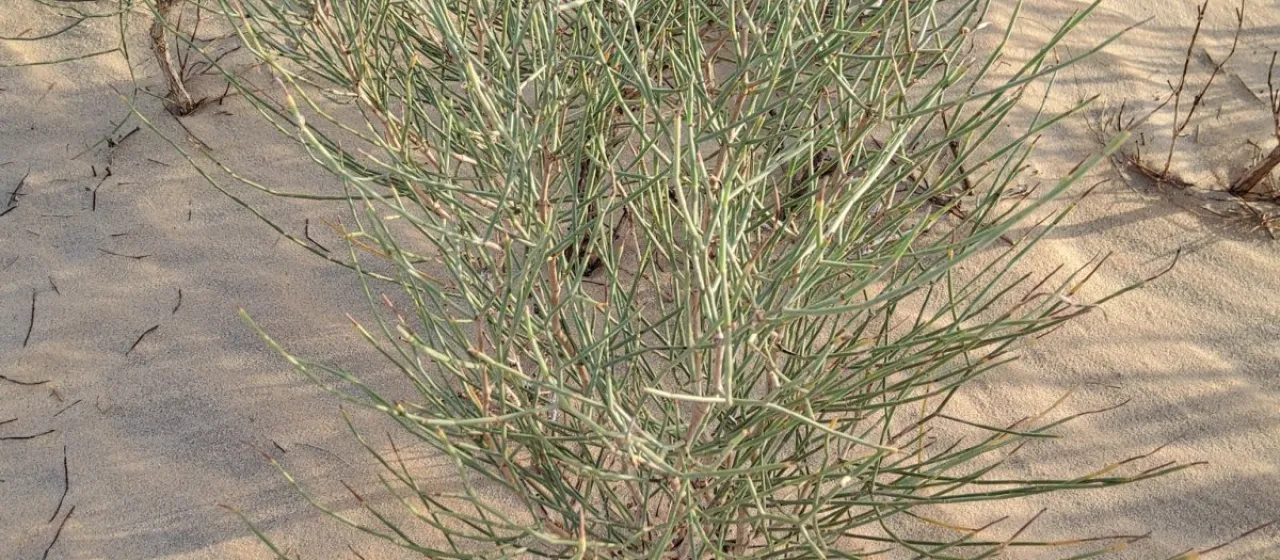
Description
Saxaul (Haloxylon persicum) is a hardy shrub or small tree belonging to the Amaranthaceae family. It is recognized globally as a critical species for the restoration of arid ecosystems and the stabilization of moving sand dunes, thriving in environments where almost no other vegetation can survive.
The native distribution of saxaul spans across the sandy deserts of Central and Western Asia. Throughout history, it has been cultivated not only for ecological protection but also as a vital resource for local communities living in harsh desert climates. It is highly valued for its ability to prevent desertification and mitigate dust storms.
Botanically, this species is characterized by its reduced, scale-like leaves and highly specialized, photosynthetic green branches. Its root system is exceptionally extensive, allowing the plant to reach deep groundwater sources. The trunk is often twisted and brittle, but the wood itself is famously dense and serves as an excellent source of heat when burned.
The agrotechnique for saxaul cultivation focuses on direct seeding methods. Because the seeds are ephemeral, they must be sown shortly after collection during favorable moisture conditions. Maintenance is minimal; however, young plants are vulnerable and must be protected from livestock grazing for several years to ensure successful establishment.
- Sand dune fixation and soil erosion control.
- Restoration of degraded desert ecosystems.
- Provision of fuel and winter fodder for camels.
- Creation of windbreaks for agricultural fields.
Typical pests affecting saxaul include various types of beetles and weevils that feed on the bark and green shoots. Fungal diseases can also occur if the humidity levels are abnormally high for a prolonged period. Despite these pressures, Haloxylon persicum remains the most reliable biological tool for managing desert landscapes and preventing the spread of sandy deserts.