
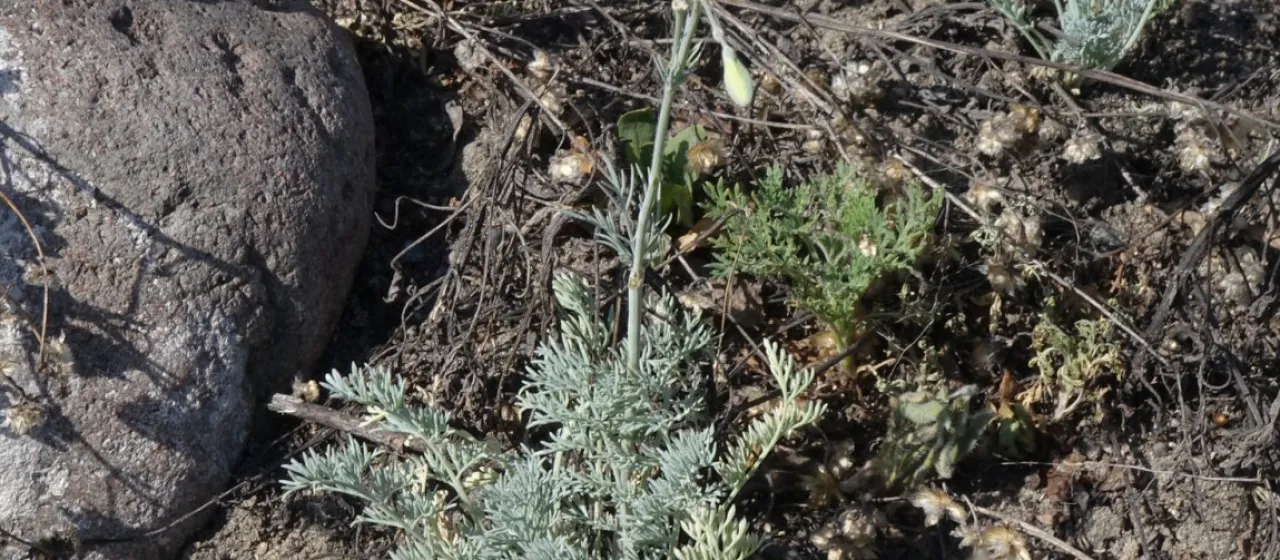
Description
Hypecoum erectum is an annual herbaceous plant belonging to the Papaveraceae family. It is a resilient species that has evolved to thrive in some of the more challenging, arid environments across the Eurasian continent, often appearing in disturbed soils and steppe landscapes.
The native range of this plant extends across large parts of Eastern Europe, Central Asia, Siberia, and Mongolia. It is typically found in well-drained habitats, such as sandy riverbanks, arid slopes, and open fields. Due to its opportunistic nature, it is frequently classified as a weed in agricultural settings where soil has been disturbed.
Botanically, it presents as a low-growing plant with a basal rosette of finely divided, glaucous leaves. Its stems are erect and can reach heights between 10 and 30 centimeters. The plant produces small, yellow, distinctively shaped flowers. The fruit is a linear, often curved capsule that holds numerous small seeds, which facilitates its rapid dispersal.
The plant demonstrates a strong preference for high solar irradiance and sandy or loamy soils with low water retention. It is highly drought-tolerant, which makes it well-adapted to the steppe climate. It does not require intensive cultivation techniques and, in many regions, is actively managed as an unwanted species in grain and vegetable fields.
The primary economic use of Hypecoum erectum lies in its scientific potential; researchers investigate the plant for its alkaloid content, which may have pharmacological properties. From an agricultural standpoint, it is primarily monitored due to its potential to become an invasive weed that competes with crops for soil nutrients and moisture in arid zones.
- High tolerance to arid and semi-arid climates.
- Rapid lifecycle completion in favorable conditions.
- Presence of biologically active alkaloids.