
Description
Hypecoum procumbens is an annual herbaceous plant belonging to the Papaveraceae family. Known for its prostrate growth habit, it is a characteristic species of arid and semi-arid regions, often found in disturbed soils and Mediterranean-type habitats where it competes effectively with other vegetation.
The plant originates from the Mediterranean and Black Sea basins. It typically thrives in regions with warm, dry summers and mild winters. As an agricultural interest, it requires a well-draining soil profile, as it is highly susceptible to root diseases caused by waterlogging in heavy clay environments.
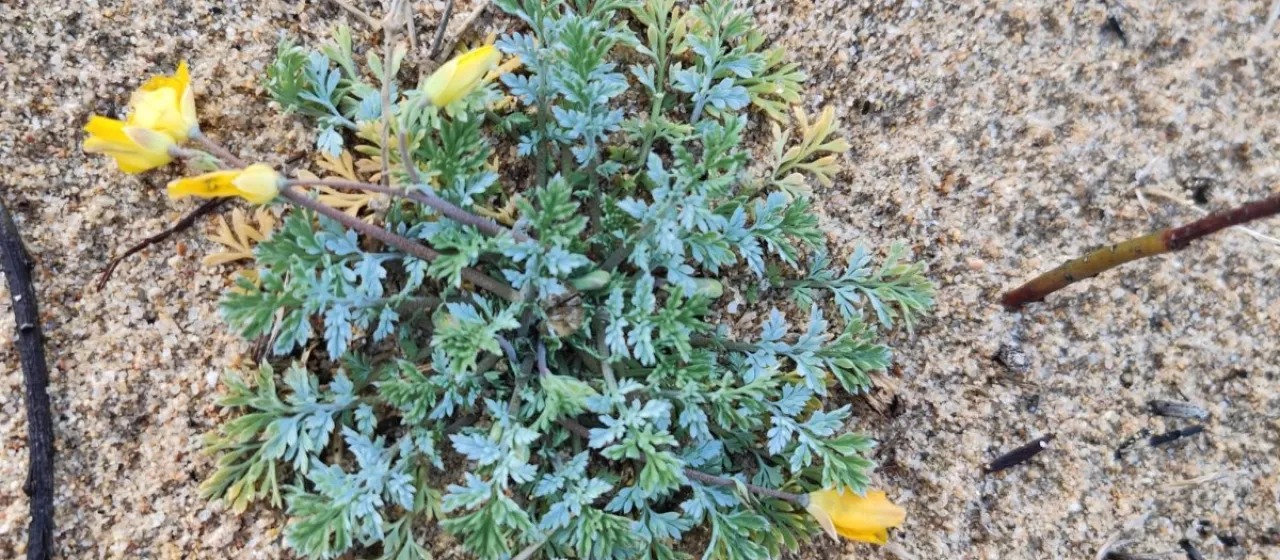
Botanical features include deeply dissected, glaucous leaves arranged in a rosette and distinctive yellow, four-petaled flowers. The fruit is a curved, pod-like capsule that dehisces at maturity, scattering seeds to facilitate propagation. The root system is deep and taproot-like, allowing the plant to reach moisture in sandy substrates.
Agrotechnical requirements for Hypecoum procumbens include a sunny exposure and low-nitrogen fertilizers, as the plant is adapted to nutrient-poor conditions. Sowing should occur in late winter or early spring to ensure the plants establish themselves before the onset of extreme summer heat. Weed control is essential during the early stages of development.
The plant is mainly studied for its alkaloid content, which holds promise for pharmaceutical research. However, in standard field operations, it is frequently treated as a weed that requires monitoring to prevent overpopulation in nearby commercial crops. Common pests include aphids and mites, while fungal pathogens generally arise only under conditions of excessive humidity.