
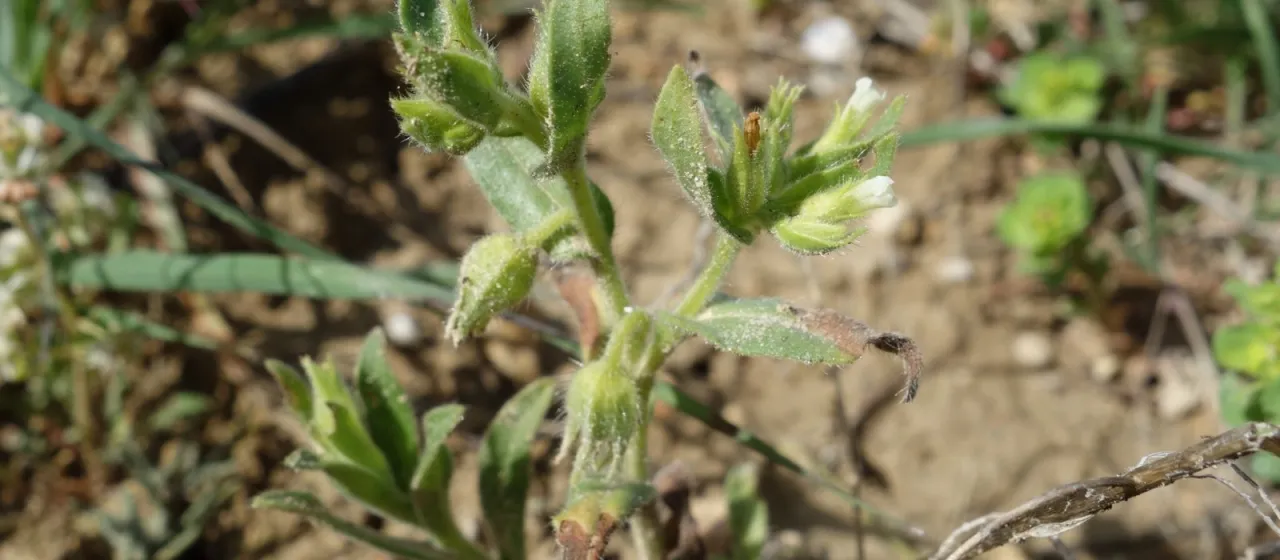
Description
Nonea pallens is a perennial herbaceous plant belonging to the Boraginaceae family. While not a conventional crop for large-scale agriculture, it is recognized by botanists and agronomists as a species of interest due to its remarkable adaptation to arid and semi-arid environments.
The plant originates from the arid regions of Central Asia and the Caucasus. It is natively found in habitats characterized by extreme environmental stress, including high solar radiation, low precipitation, and nutrient-poor, stony or saline soils. This evolutionary history makes it a resilient candidate for landscape restoration and ecological stabilization projects.
Botanically, Nonea pallens is defined by its deep taproot system, which allows it to thrive during seasonal droughts, and its pubescence, which protects the plant from excessive evaporation and direct sunlight. The flowers, which display a distinct pale-yellow or cream color, are a critical resource for local pollinators, supporting biodiversity in harsh steppe ecosystems.
Agricultural requirements for this species are minimal. It thrives in well-drained soils and requires direct sunlight for optimal growth. Because it is highly adapted to its natural environment, it does not require significant fertilization or irrigation. However, farmers or researchers interested in cultivating it should ensure that the planting site has excellent drainage to prevent root rot, which is the primary limitation for the species in more temperate regions.
In terms of хозяйственное (utility) value, Nonea pallens is being studied for its medicinal properties and its role as a honey plant. Its ability to colonize degraded lands makes it useful for soil erosion control. Regarding pests and diseases, the plant is naturally robust and rarely susceptible to severe infections in its typical semi-desert range, making it a low-maintenance species for specialized ecological cultivation.
- Excellent drought resistance.
- Well-suited for degraded, saline soils.
- Beneficial for local pollinator populations.
- Low input requirements for cultivation.