
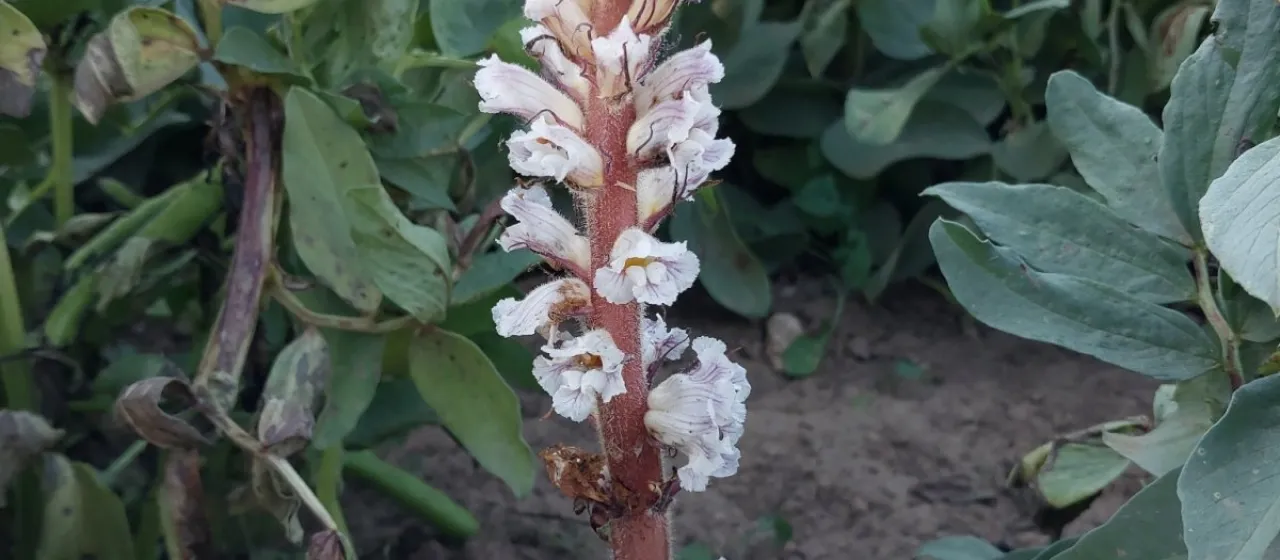
Description
Crenate broomrape (Orobanche crenata Forssk.) is an obligate root parasitic plant belonging to the Orobanchaceae family. Completely devoid of chlorophyll, it cannot perform photosynthesis. Instead, it relies entirely on the host plant for water, minerals, and carbohydrates, which it absorbs through specialized structures called haustoria that penetrate the roots of the host.
The native range of this species extends across the Mediterranean basin, the Middle East, and North Africa. It thrives in temperate to warm climates, where it represents a persistent threat to agricultural productivity. The seeds of the broomrape are extremely resilient and can remain dormant in the soil for over a decade, waiting for the chemical cues released by a suitable host plant root.
Botanically, the plant develops an erect, fleshy stem covered with scale-like leaves, typically growing 20 to 80 centimeters tall. Its inflorescence is a dense, terminal spike of white or pale-violet flowers. One single plant can produce an enormous number of minute, dust-like seeds that are easily disseminated by wind, water, and through contaminated agricultural machinery.
Management of Orobanche crenata relies on an integrated pest management (IPM) approach. This includes:
- Extended crop rotation using non-host crops like cereals or grasses.
- Utilization of resistant or tolerant cultivars of legumes.
- Deep soil tillage to bury seeds beyond their germination range.
- Chemical control measures, including the application of herbicides at specific stages.
From an agricultural standpoint, the crenate broomrape is considered a highly destructive weed. It primarily targets legumes such as faba beans, lentils, chickpeas, and vetch. Infested fields show patchy growth, stunted plants, and reduced pod set. Severe infestations can cause total crop failure, making it a priority target for weed management programs in arid and semi-arid farming regions.