
Description
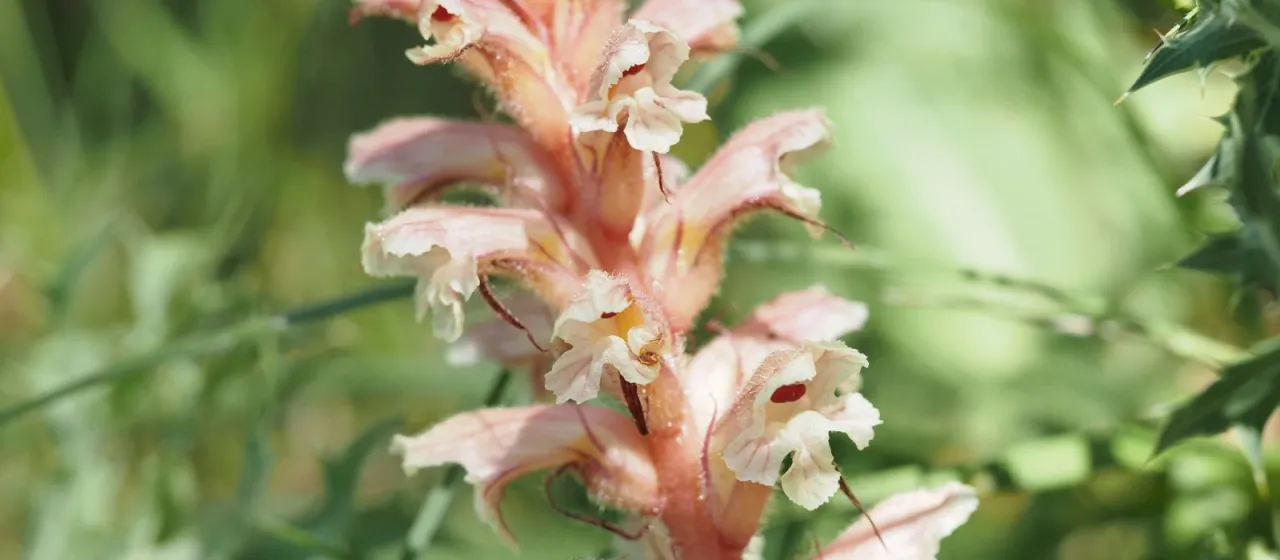
Amethyst broomrape (Orobanche amethystea Thuill.) is a parasitic flowering plant belonging to the Orobanchaceae family. It lacks chlorophyll entirely and relies completely on a host plant for nutrients and water. Unlike photosynthetic plants, it survives by tapping into the vascular system of the host through specialized root-like structures called haustoria.
The native range of this species includes parts of Europe and the Mediterranean basin, where it thrives in warm, sunny, and dry environments. It is not cultivated for any purpose; instead, it is classified as a troublesome parasitic weed in agricultural landscapes. Its presence poses a significant threat to crop health, as it competes for water and nutrients, leading to stunted growth and reduced yields in infested areas.
Botanically, the plant consists of a single, fleshy stem reaching heights of 10–40 cm, often displaying a striking amethyst or violet-brown hue. Its leaves are reduced to small, brown scales. The plant produces a terminal spike of dense, tubular flowers. A single plant can produce thousands of microscopic seeds, which are highly resilient and can remain dormant in the soil for many years until they detect the root exudates of a compatible host.
Ecological requirements are dictated by the host plant species, which often include members of the Asteraceae and Fabaceae families. Amethyst broomrape prefers well-drained soil conditions that facilitate the germination of its tiny seeds. Its life cycle is entirely dependent on host availability: germination is triggered only by chemical stimulants released from the roots of a susceptible plant.
Management of Amethyst broomrape is complex due to its intimate biological connection with the host. Agronomic control strategies focus on:
- Crop rotation with non-host species to deplete the soil seed bank.
- The use of resistant crop varieties.
- Strict phytosanitary control to prevent the spread of contaminated soil or seeds.
- Biological control methods involving specialized insects or fungi that target broomrape development.