
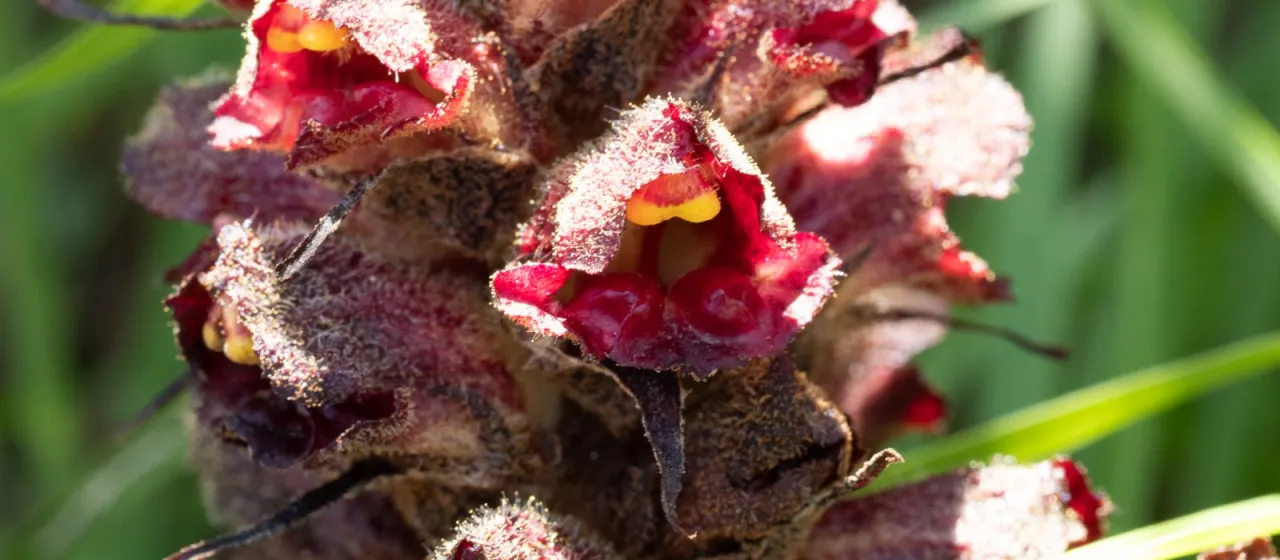
Description
Variegated broomrape (Latin Orobanche variegata) is a parasitic herbaceous plant belonging to the Orobanchaceae family. It is a non-photosynthetic organism that lacks chlorophyll entirely, making it dependent on the root systems of host plants for survival. By forming specialized structures called haustoria, it penetrates the host's vascular system to extract water and nutrients.
The species is primarily distributed across the Mediterranean basin, the Caucasus, and parts of the Middle East. It thrives in open, sunny environments with well-drained soils, often colonizing arid lands and grasslands. While it has specific hosts in the wild, its presence in agricultural fields can be detrimental to various crops that fall within its host range.
Botanically, the plant is characterized by an erect, fleshy stem adorned with scale-like leaves. Its floral spikes produce distinctive, often brightly colored blooms, which facilitate the production of vast amounts of minute, wind-dispersed seeds. These seeds are remarkably resilient and can remain dormant in the soil for extended periods, waiting for chemical signals from host roots to initiate germination.
Agricultural management of this parasite relies heavily on integrated pest management (IPM) strategies. Since the plant completes its vegetative development underground, traditional herbicide applications are often ineffective. Crop rotation using non-host species is the most common preventative measure, aimed at reducing the seed bank in the soil over several growing seasons.
The economic impact of Orobanche variegata is significant, as infestation leads to physiological stress in host plants. This manifests as stunted growth, reduced biomass, and severe drops in seed or fruit yield. By hijacking the nutrient flow of the host, the broomrape acts as a major limiting factor for agricultural productivity in infested regions.
- Obligate holoparasite
- No photosynthetic capacity
- High reproductive output
- Requires host-root exudates for germination