
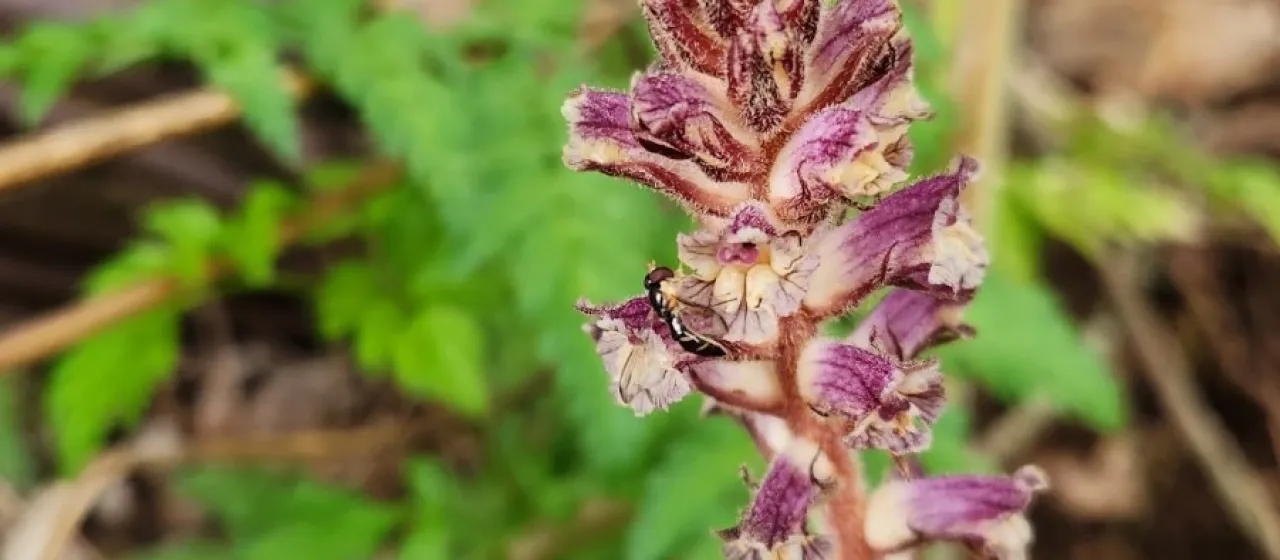
Description
Common broomrape (Orobanche minor) is a root parasitic plant belonging to the Orobanchaceae family. As an obligate parasite, it lacks chlorophyll and cannot perform photosynthesis. Consequently, it relies entirely on its host plant for nutrients and water, extracting them through specialized underground structures known as haustoria which penetrate the host's vascular system.
Originally native to the Mediterranean region, it has since become naturalized in many parts of the world, including Europe, New Zealand, Australia, and parts of the United States. It is a highly opportunistic parasite, known to affect various broad-leaved crops such as clover, legumes, sunflowers, and tobacco, significantly impacting the productivity of agricultural fields.
Botanically, Orobanche minor grows as a sturdy, upright stem, typically reaching heights of 10 to 50 centimeters. The stems are yellowish, brownish, or purplish in color, lacking green leaves and instead possessing scale-like appendages. The inflorescence is a dense spike of many tubular flowers, which are often self-pollinated. This ensures a massive production of dust-like seeds that can remain viable in the soil for over a decade.
Agricultural management is challenging because the parasite is already well-established once the flowering stems emerge above the soil. Effective control strategies prioritize preventative measures. These include long rotations with non-host crops, maintaining soil health, and ensuring strict seed certification to prevent the introduction of broomrape seeds into new fields.
The economic impact of common broomrape is significant, often resulting in severe yield losses in infested crops. While there are natural enemies of the plant, including the biological control agent Phytomyza orobanchia, they are rarely sufficient to eradicate the infestation. Therefore, farmers must integrate chemical, mechanical, and cultural practices to minimize the presence of this persistent parasite in the ecosystem.