Hairy lousewort
Pedicularis hirsuta
Description
Hairy lousewort, scientifically known as Pedicularis hirsuta, is a perennial herbaceous plant belonging to the Orobanchaceae family. This species is highly adapted to the harsh conditions of arctic and subarctic regions, where it thrives despite the brief growing season and cold temperatures.
The distribution range of this plant includes the northern territories of North America, Europe, and Asia. It is typically found in tundra environments, rocky outcrops, and mountainous terrain, where its resilience allows it to survive in nutrient-poor and frozen substrates.
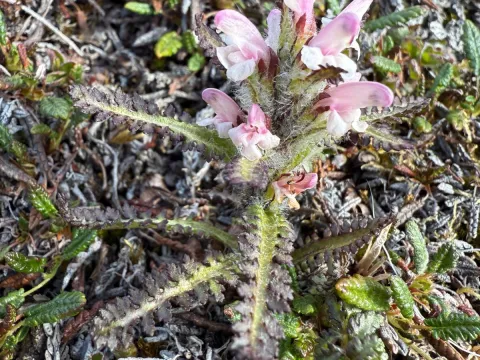
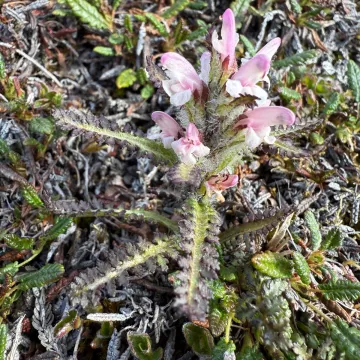
Botanically, the plant is characterized by its distinct hairy stems, which provide thermal insulation in freezing conditions. The leaves form a basal rosette, and the flowers are arranged in a dense, spike-like inflorescence, featuring a unique shape typical of the Pedicularis genus.
As a hemiparasitic plant, Hairy lousewort obtains water and minerals by attaching its root system to the roots of neighboring plants. This adaptation is crucial for its survival, allowing it to supplement its nutrient intake in environments where direct soil absorption is limited.
While this plant is not a commercial agricultural crop, it remains a subject of scientific interest for ecologists and botanists. It serves as an important indicator of ecosystem health in the Arctic and is studied for its unique evolutionary adaptations to high-latitude climates.
- Family: Orobanchaceae
- Classification: Hemiparasitic herb
- Habitat: Arctic tundra
- Distinguishing features: Pubescent stems
- Primary use: Ecological research
Photo gallery