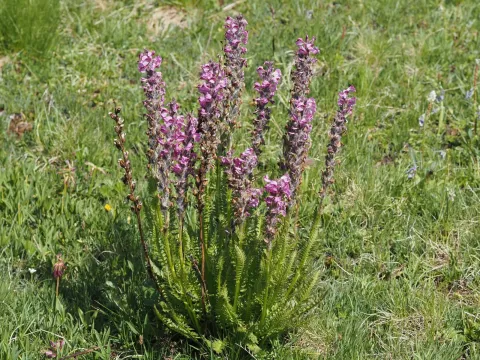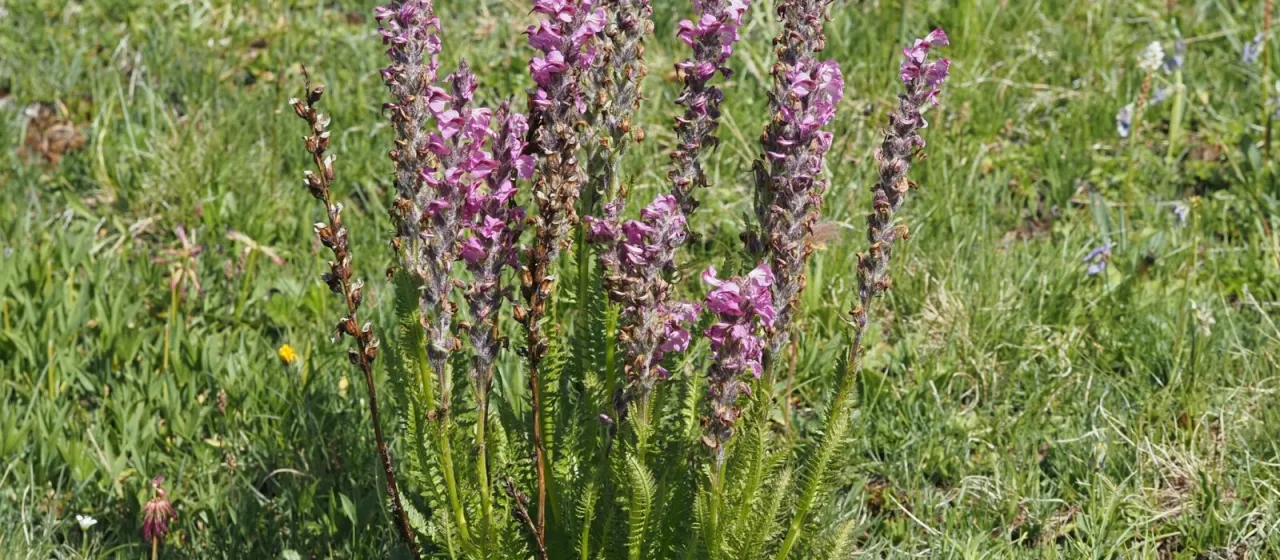
Description
Pedicularis rostratospicata, commonly known as the beaked lousewort, is a herbaceous perennial plant belonging to the family Orobanchaceae. Often found in mountain ecosystems, this species serves as a perfect example of botanical adaptation to extreme cold and nutrient-poor environments, where survival depends on specialized biological interactions.
The plant is native to the high-altitude regions of Europe, particularly within the Alps. It prefers subalpine and alpine meadows, typically thriving on calcareous soils. Its distribution is restricted by the need for specific environmental conditions, including a short growing season and the presence of suitable host plants for its survival strategy.
Botanically, the plant is characterized by its spike-like inflorescence, which is densely packed with flowers. Each flower features a distinctive beak-shaped corolla, an evolutionary adaptation designed to attract specific bumblebee species for pollination. The foliage is primarily basal or alternate, providing enough leaf surface for photosynthesis during the brief alpine summer.
As a hemiparasite, the beaked lousewort is not a crop in the traditional sense. It possesses specialized root structures called haustoria, which penetrate the root systems of neighboring plants to tap into their vascular tissue. This mechanism allows the plant to acquire water and essential minerals, reducing its reliance on soil nutrients but making it detrimental to agricultural forage if it occurs in high densities.
There is no industrial or agricultural use for this species. Cultivation is generally not practiced as the plant is difficult to propagate outside its natural mountain environment due to its parasitic nature and specific mycorrhizal associations. Its value is strictly scientific and ecological, as it remains a key indicator species for the health of mountain grassland habitats.
In its natural habitat, the plant faces few traditional pests, though climate change presents the most significant long-term threat. Environmental stress can lead to physiological decline, making the species susceptible to opportunistic fungal pathogens during prolonged humid periods. Effective conservation strategies focus on protecting these high-altitude meadows from overgrazing and fragmentation.
Photo gallery