Hairy mistletoe
Phoradendron villosum
Description
Hairy mistletoe (Latin: Phoradendron villosum) is a perennial semi-parasitic plant belonging to the Santalaceae family. While not an agricultural crop in the traditional sense, it is a significant plant species in forestry and arboriculture, where it is classified as a pathogenic organism that affects tree health and stand vitality.
The species is native to western North America, with a distribution range extending from Oregon through California into parts of Mexico. It is most commonly found in oak woodlands and savanna-like landscapes. Its survival strategy is entirely dependent on the presence of suitable host trees, specifically various species of the genus Quercus.
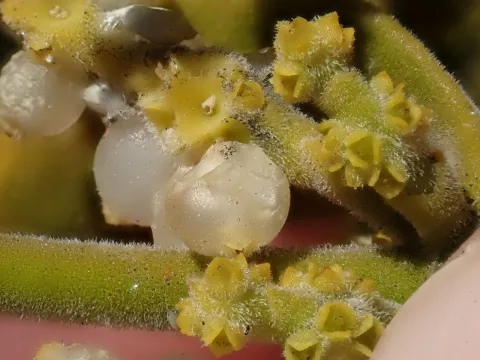
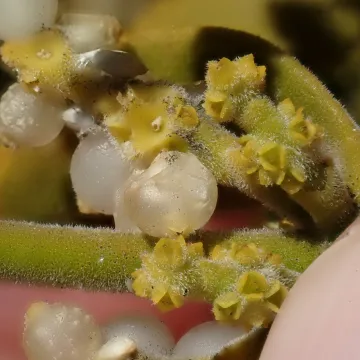
Botanically, this plant is characterized by its dense, velvety hair covering the young stems and foliage, from which the name villosum is derived. It produces small, inconspicuous flowers followed by sticky, white or pinkish berries. The plant attaches itself to the host tree via haustoria, which are specialized structures that penetrate the bark to draw water and nutrients directly from the host's vascular system.
Regarding environmental requirements, the plant thrives in areas with sufficient sunlight. Unlike some other parasites, it retains the ability to perform photosynthesis, yet it remains reliant on the host for mineral intake. It is generally sensitive to extreme arctic temperatures, which defines its northern range limits along the Pacific coast.
From a management perspective, the plant is viewed as a pest that requires monitoring in commercial and ornamental forestry. Heavy infestations can lead to reduced vigor, branch dieback, and increased susceptibility to secondary stressors like drought or insect borers. Control methods are generally limited to manual removal or pruning of affected branches in high-value timber or park landscapes.
- Member of the Santalaceae family.
- Primary host species include native oak trees.
- Seed dispersal relies on bird species consuming the fruit.
- Can contribute to significant forest damage under drought conditions.
Photo gallery