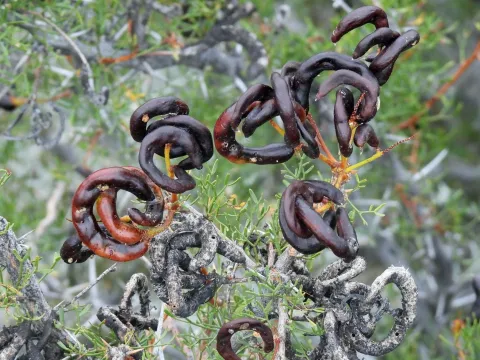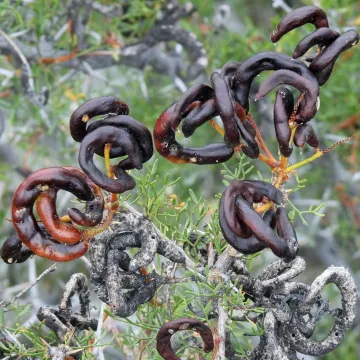
Prosopis denudans
Prosopis denudans Benth.
Description
Prosopis denudans is a perennial shrub or small tree belonging to the family Fabaceae, specifically the subfamily Mimosoideae. This species is highly regarded in botany and agriculture for its remarkable ability to thrive in extreme arid and semi-arid environments, acting as a crucial component of local ecosystems.
Originating from South America, the plant is primarily found in the dry regions of Argentina. It has adapted over millennia to survive in harsh, moisture-deficient environments. Its natural range demonstrates a high tolerance for poor, stony, or sandy soils and extreme thermal fluctuations, characteristic of the inland arid zones of the continent.
Botanically, Prosopis denudans features a deep taproot system designed to access water reservoirs deep underground. The foliage is typically small, and in periods of intense drought, the plant can reduce its transpiration rate by shedding leaves or limiting growth, which aligns with its classification as a xerophytic plant well-suited to desertification control.
Agricultural practices for this species focus on soil stabilization and range improvement rather than high-yield commercial crop production. It requires minimal intervention, as it is self-sustaining once established. It does not demand fertilizers or artificial irrigation, making it an economically viable choice for large-scale land rehabilitation projects in arid territories.
The primary agricultural and economic uses for the species include:
- Preventing soil erosion through the stabilization of sandy and unstable surfaces.
- Providing sustainable forage for livestock, particularly goats and sheep during feed shortages.
- Production of high-quality wood for firewood and charcoal.
- Serving as a host plant for pollinators in otherwise barren landscapes.
Regarding health, the plant is generally resistant to standard agricultural pests. While some seed-boring beetles (Bruchids) may impact the reproductive potential of the tree, these are considered natural ecological factors rather than threats to the plant's survival. Its inherent structural resilience ensures that fungal diseases or bacterial outbreaks are very rare in healthy, well-spaced stands.
Photo gallery