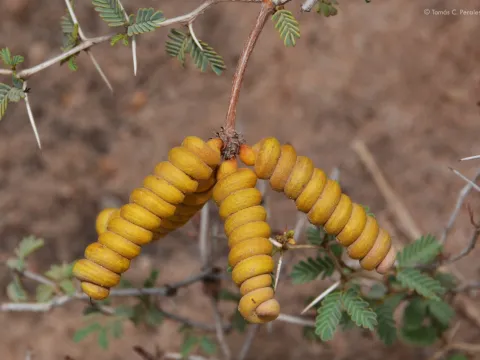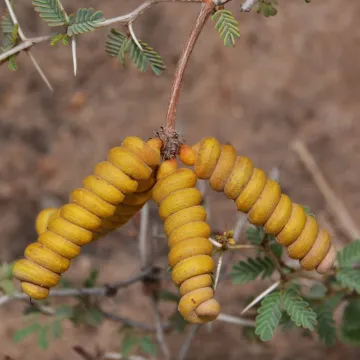
Tornillo
Prosopis reptans Benth.
Description
Tornillo (Prosopis reptans Benth.) is a hardy perennial legume belonging to the Fabaceae family, subfamily Mimosoideae. It is distinguished from other species in the Prosopis genus by its unique creeping growth habit, which allows it to thrive in harsh, low-rainfall environments.
The plant is native to the arid and semi-arid regions of South America, specifically in parts of Argentina. It has evolved to survive in extreme conditions, often serving as a pioneer species in desertification-prone areas where it plays a critical role in stabilizing fragile ecosystems.
Botanically, it is a low-growing shrub that features horizontal branches capable of rooting at the nodes. The leaves are bipinnate, typical of the genus, and the stems are equipped with sharp spines. These spines serve as an evolutionary defense mechanism against herbivore browsing in environments where vegetation is scarce.
In terms of climatic and soil requirements, Prosopis reptans is exceptionally resilient. It favors hot, arid climates and is highly tolerant of drought. It can grow in a wide range of soil types, including saline, sandy, and stony soils, where it performs well without significant inputs or specialized agricultural management.
The primary agricultural and environmental use of this plant is soil conservation. Due to its vigorous root system, it is highly effective at preventing soil erosion and improving soil structure. Furthermore, like many legumes, it assists in nitrogen fixation, which can help enrich otherwise depleted desert soils.
Regarding health, the plant is generally robust. However, it can be susceptible to seed-feeding insects, such as bruchid beetles, which can affect its reproductive success. Pathogenic concerns are minimal unless the plant is subjected to waterlogged conditions, which can lead to root rot or fungal outbreaks unsuited to its desert nature.
Photo gallery