Riccia beyrichiana
Riccia beyrichiana
Description
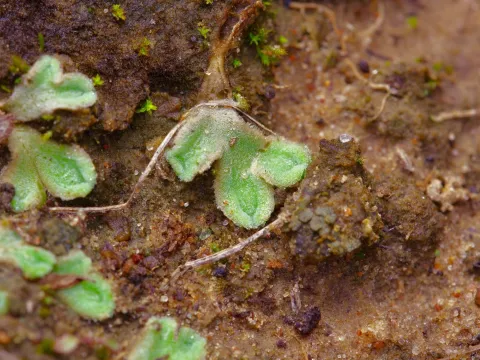
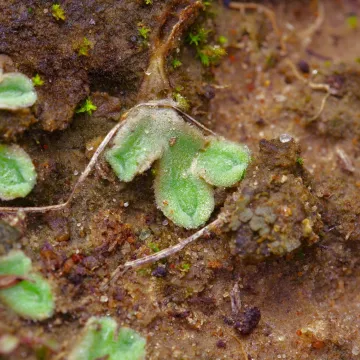
Riccia beyrichiana is a species of liverwort belonging to the family Ricciaceae. Unlike some of its aquatic counterparts, this is an exclusively terrestrial plant that typically forms small, rosette-like colonies on damp soil surfaces. It represents a primitive group of land plants, characterized by a thalloid body that lacks vascular tissues, relying on osmosis for water distribution.
The native range of this species extends across various temperate regions of the Northern Hemisphere, including parts of North America and Europe. It typically colonizes disturbed habitats such as bare soil in agricultural fields, damp pathways, and stream banks. Its ability to colonize exposed mineral soil makes it a pioneer species in certain ecological successions.
The morphology of the plant is defined by its dichotomously branched thallus, which creates a neat, circular or semi-circular rosette. The edges of the thallus are often ascending or slightly curved. The reproductive organs are embedded within the tissue of the upper surface, and the maturation of spores is a critical stage in the plant's seasonal lifecycle, often triggered by changes in ambient moisture levels.
Agricultural requirements for Riccia beyrichiana are centered on moisture management and substrate quality. It thrives in humid environments with high atmospheric moisture and prefers neutral to slightly acidic, loamy, or clay-based soils that do not suffer from prolonged waterlogging. Light should be indirect to prevent desiccation of the delicate thalloid tissues.
In terms of хозяйственное usage, Riccia beyrichiana is primarily studied for its role in soil ecology and as a bio-indicator for environmental health. While not a commercial crop, it is of great interest to botanical researchers. Typical pests and diseases include fungal infections, which are prevalent if stagnant water is present, and competition from fast-growing vascular weeds that can overshadow the small bryophyte colonies.
Photo gallery