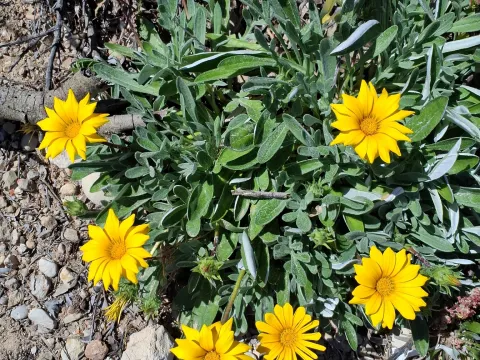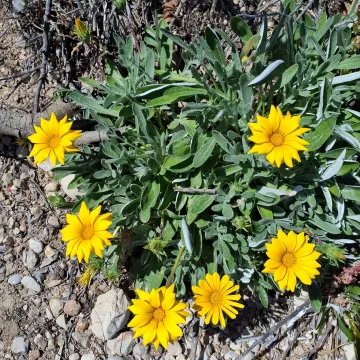
Treasure flower
Gazania rigens (L.) Gaertn.
Description
Gazania rigens, commonly known as the treasure flower, is a charming flowering plant belonging to the Asteraceae family. Although it is a perennial in its native environment, it is widely cultivated in agriculture and horticulture as an annual plant in regions with cold winters. Its intense, radiant blooms make it a staple for low-maintenance landscaping and commercial flower production.
The species originated in Southern Africa, where it evolved to thrive in arid and coastal environments. This historical adaptation allows the plant to withstand high heat and intense sunlight, making it highly drought-tolerant. Its natural range has expanded globally, and it is now extensively cultivated across Mediterranean-type climates for both residential gardens and public landscapes.
Botanically, the treasure flower is characterized by a basal rosette of leaves, which are often silvery-gray on the underside due to a dense layer of trichomes. These hairs help the plant minimize water loss. The flowers are daisy-like, with long petals that display vibrant shades of yellow, orange, and bronze. Notably, the flower heads are heliotropic, opening only during sunny periods.
Successful cultivation of Gazania rigens depends on strictly observing specific agronomic requirements:
- Full sun exposure is critical for both flowering and overall vigor.
- Well-draining, sandy or loamy soils prevent the root rot to which the species is susceptible.
- Controlled irrigation practices, as the plant prefers cycles of moisture and drying.
- Regular deadheading to prolong the blooming period throughout the growing season.
In terms of хозяйственное (economic) use, the treasure flower is primarily employed as a decorative element in drought-resistant xeriscaping. Regarding plant protection, the main threats include powdery mildew and fungal crown rot, usually resulting from over-irrigation. Insect pests such as aphids or spider mites may occur in greenhouse conditions, necessitating prompt integrated pest management.
Photo gallery