


SKU #69732
·
37 views
ECLIPSE
Aster
User rating
0 votes0% positive reviews
No ratings yet — be the first.
Type of Astro
Perennial
Plant Height
50-80
Flower diameter, cm
8-10
Flower Shape
Peony-like
About product

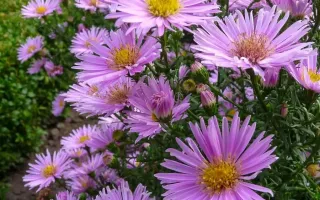
The "Eclipse" aster is a compact plant standing 50-60 cm tall with a bush diameter of about 23 cm. Its peony-like flower heads are dark purple with a sheen, reaching 8-10 cm in diameter. The tongue-shaped florets are tightly pressed against each other and curve inward, giving the flowers special decorative appeal. Blooming occurs from August to September, during which 5-6 flower heads open simulta…
Type of Astro
Perennial
Plant Height
50-80
Flower diameter, cm
8-10
Flower Shape
Peony-like
Description
The "Eclipse" aster is a compact plant standing 50-60 cm tall with a bush diameter of about 23 cm. Its peony-like flower heads are dark purple with a sheen, reaching 8-10 cm in diameter. The tongue-shaped florets are tightly pressed against each other and curve inward, giving the flowers special decorative appeal. Blooming occurs from August to September, during which 5-6 flower heads open simultaneously on the plant, creating an effective and luxurious display.
For successful cultivation of the "Eclipse" aster, choose well-lit areas with fertile clay-loam or loamy sand soil. The plant has high cold hardiness and can withstand frosts down to -3 to -4 °C. It is usually grown via seedlings: seeds are sown in March-April at a depth of about 0.5 cm, and seedlings appear within 7-14 days. Seedlings are transplanted when the first pair of true leaves appears at a spacing of 5x5 cm, and planted in open ground in the second half of May with an interval of about 20 cm between plants. Winter sowing is also possible at the end of October, followed by mulching with peat or sawdust.
Care involves regular watering, careful soil loosening considering the surface location of roots, and fertilizing to maintain health and abundant blooming. The "Eclipse" aster is widely used for cutting and arranging flower beds, borders, as well as creating decorative compositions on the site thanks to its attractive coloring and resistance to unfavorable conditions.
For successful cultivation of the "Eclipse" aster, choose well-lit areas with fertile clay-loam or loamy sand soil. The plant has high cold hardiness and can withstand frosts down to -3 to -4 °C. It is usually grown via seedlings: seeds are sown in March-April at a depth of about 0.5 cm, and seedlings appear within 7-14 days. Seedlings are transplanted when the first pair of true leaves appears at a spacing of 5x5 cm, and planted in open ground in the second half of May with an interval of about 20 cm between plants. Winter sowing is also possible at the end of October, followed by mulching with peat or sawdust.
Care involves regular watering, careful soil loosening considering the surface location of roots, and fertilizing to maintain health and abundant blooming. The "Eclipse" aster is widely used for cutting and arranging flower beds, borders, as well as creating decorative compositions on the site thanks to its attractive coloring and resistance to unfavorable conditions.
Specifications
| Type of Astro | |
|---|---|
| Plant Height | 50-80 |
| Flower diameter, cm | 8-10 |
| Flower Shape | |
| Flower Color | |
| Assignment | |
| Cold Resistance | |
| Catalog | Catalog → Aster |
| Originator | Котов Василий Владимирович |
| Patent holder | Котов Василий Владимирович |
| Country | Russia |
Store offers
Prices are updated on loadLoading offers…
Aggregator catalog: prices are collected automatically from store websites, normalized by AI and converted at the current exchange rate. Before ordering, confirm the price and availability on the store's website. This block is not indexed by search engines — the data is loaded after the page opens.
See also
Often considered together with this variety


Recently viewed
Similar items in this catalog section



Comments · 0