


SKU #3602
·
385 views
Bere Napoleon (Napoleon, Bonaparte)
Pear
User rating
1 vote100% positive reviews
No ratings yet — be the first.
Type of Sort
Autumn variety of pear
About product

Autumn variety, developed in 1808 in Mons (Belgium) by gardener N. Liar. It was registered in the Krasnodar region. Grows in the North Caucasus, Crimea, southwestern Ukraine, and republics of Central Asia.
Tree is low-growing with a broad-pyramidal, sparse crown. Main branches are long and thick; upper branches are angled at 30°, lower ones at 40°. Trunk is slender; bark of trunk and branches…
Type of Sort
Autumn variety of pear
Description
Autumn variety, developed in 1808 in Mons (Belgium) by gardener N. Liar. It was registered in the Krasnodar region. Grows in the North Caucasus, Crimea, southwestern Ukraine, and republics of Central Asia.
Tree is low-growing with a broad-pyramidal, sparse crown. Main branches are long and thick; upper branches are angled at 30°, lower ones at 40°. Trunk is slender; bark of trunk and branches is gray-brown.
Shoots are gray-brown. Buds are large, pointed, and slightly raised. Leaves are medium-sized, egg-shaped or broadly egg-shaped. Leaf blade is thick, light green, smooth, glossy. Leaf margins are finely serrated, sparse, and distinctly pronounced.
Flowers are large, petals are elongated-oval, gradually narrowing toward the base. Blooms late and for an extended period, allowing fruits to set even in years with late spring frosts.
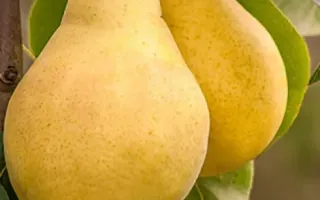
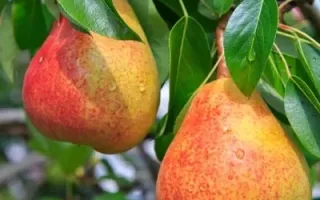
Fruits are medium-sized, bell-shaped or pear-shaped. Skin is thin, smooth, glossy, gray-green in immature fruits, turning attractive yellowish hue upon ripening, sometimes with a delicate pink blush on the sun-exposed side. Subcutaneous dots are small and rust-colored. Calyx is half-open, sepals are broad and short, disk is small and covered with rust, pedicel is medium-length, fairly thick, with a flared tip at the upper end, and the cavity is very small or usually absent. Heart is bulb-like; chambers are large and elongated; calyx tube is round. Seeds are large, light-brown.
Flesh is white, juicy, tart-sweet, tender, melting, and of excellent flavor. In Kuban conditions, fruits contain 15.0% dry matter, 9.2% sugars, 0.32% titratable acids, 6.2 mg/100g ascorbic acid, and 75.6 mg/100g raw material of P-active catechins.
Harvesting maturity occurs from September 10 to 20, storage life extends until mid-November.
Fruits do not hold well on the tree. Transportability is good, though skin is delicate and requires careful handling during harvesting and packaging.
Fruits are used exclusively for fresh consumption.
Variety is partially self-fertile. Best pollinators for this variety are: Bere Ardapon, Bere Bosk, Duches Angouleme. On quince, Bere Napoleon grows poorly, so grafting is recommended only onto pear.
Trees begin fruiting from age 6. Average yield in central Kuban region at ages 17-20 years — 130-150 centners/ha, in foothill zone at ages 24-26 years — 180-200 centners/ha.
Variety is drought-tolerant but insufficiently winter-hardy. In Rostov Oblast, trees suffer from freezing both in nurseries and in gardens. In other regions of the North Caucasus, during harsh winters, Bere Napoleon also experiences significant wood, fruiting, and growth part damage; however, it usually overwinters well. Susceptible to scab and leaf spot disease.
Advantages of the variety: early and regular fruiting, good fruit flavor.
Disadvantages of the variety: insufficient winter hardiness of trees, susceptibility to scab.
Crop & resistance
Crop
Specifications
| Type of Sort | |
|---|---|
| Catalog | Catalog → Pear |
Store offers
Prices are updated on loadLoading offers…
Aggregator catalog: prices are collected automatically from store websites, normalized by AI and converted at the current exchange rate. Before ordering, confirm the price and availability on the store's website. This block is not indexed by search engines — the data is loaded after the page opens.
Alternatives
Common pear · similar varieties




See also
Often considered together with this variety


Recently viewed
Similar items in this catalog section


Comments · 0