


SKU #3753
·
444 views
Uralian Thin-Branched Pear
Pear
User rating
0 votes0% positive reviews
No ratings yet — be the first.
Type of Sort
Summer variety of pear
About product

Late-season variety from the Sverdlovsk Experimental Fruit Station. Obtained by crossing Temya with Thin-Branched Pear. Author: L. A. Kotov. Undergoes State Testing and production trials in the Sverdlovsk region.
Medium-sized tree with a crown shape close to spherical but with more spreading branches. Main branches have light brown-gray bark, initially raised upward but later spread outward. F…
Type of Sort
Summer variety of pear
Description
Late-season variety from the Sverdlovsk Experimental Fruit Station. Obtained by crossing Temya with Thin-Branched Pear. Author: L. A. Kotov. Undergoes State Testing and production trials in the Sverdlovsk region.
Medium-sized tree with a crown shape close to spherical but with more spreading branches. Main branches have light brown-gray bark, initially raised upward but later spread outward. Fruit set occurs on spurs and multi-year fruiting branches, starting from the 2nd-3rd year.
Shoots are relatively slender, straight, round in cross-section, light brown. Leaves are dark green, glossy, elliptical, slightly lobed, slightly drooping, with smooth or slightly serrated margins, on long petioles, with small, scale-like stipules.
Flowering is late, flowers are small and white.
Fruits are below average size, one-dimensional, weighing 100 g. Skin is dry, smooth, thin.
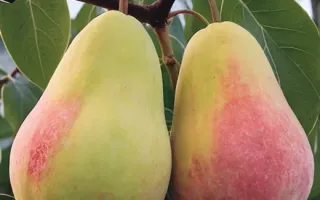
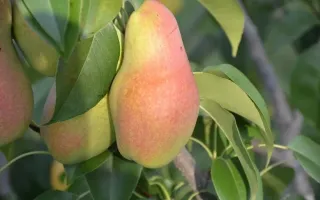
Fruits externally resemble the medium-sized Russian variety Thin-Branched Pear: pear-shaped, yellow, with a bright pink blush on the sun-exposed side, on a long, usually curved peduncle. A shallow open receptacle at the base, with a small conical nectar tube. The core is bulbous, with a small central cavity, closed seed chambers.
Flesh is yellowish-white, relatively firm, free of gritty cells, finely textured, juicy, sweet-tart in flavor, ripening in late summer or early autumn. Chemical composition of the fruit: soluble solids — 14.9% (up to 15.6%), total sugars — 11.5% (up to 12.5%), titratable acids — 0.85% (up to 0.9%) on fresh weight, ascorbic acid — 6.6 mg/100g (up to 9.4 mg/100g), and P-active substances (catechins) — 452.2 mg/100g (up to 702.8 mg/100g) of flesh.
Fruits are consumed fresh and suitable for processing.
Fruit-bearing begins on the fifth year after grafting.
Yield is good and annual. The variety is resistant to scab.
Advantages of the variety: winter hardiness, yield, good taste and appearance.
Disadvantages of the variety: taste quality decreases in cold summers and on poor soils.
Crop & resistance
Crop
Disease resistance
Specifications
| Type of Sort | |
|---|---|
| Catalog | Catalog → Pear |
Store offers · 2 from 2 stores
Prices are updated on loadLoading offers…
Aggregator catalog: prices are collected automatically from store websites, normalized by AI and converted at the current exchange rate. Before ordering, confirm the price and availability on the store's website. This block is not indexed by search engines — the data is loaded after the page opens.
Alternatives
Common pear · similar varieties





See also
Often considered together with this variety


Recently viewed
Similar items in this catalog section


Forest Beauty (Alexandrina, Marie-Louise)
From your browsing history
32.1K 5 offers
3 670 €за 1000 шт ≈ 187 388 ₴

Comments · 0