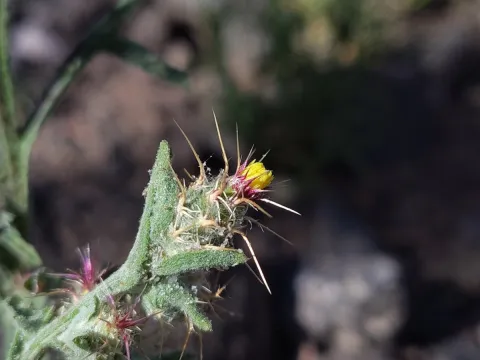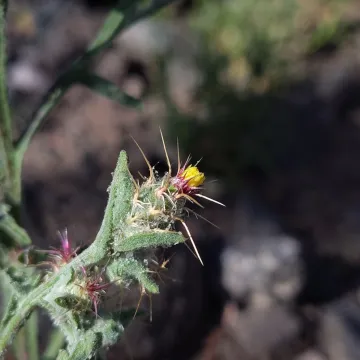
Maltese starthistle
Centaurea melitensis L.
Description
Maltese starthistle (Latin Centaurea melitensis L.) is an annual herbaceous plant belonging to the Asteraceae family. While widely recognized in many agricultural regions as an invasive weed due to its aggressive growth, it serves as a significant honey plant, providing crucial nectar resources during dry seasons when other flora may be dormant.
The native range of this species is the Mediterranean basin, but it has naturalized globally, particularly in temperate and subtropical climates. It thrives in open, sunny environments, often dominating degraded pastures, roadside verges, and various types of disturbed or agricultural lands.
The plant exhibits a characteristic branching stem covered with fine, greyish hairs, typically growing between 20 and 80 centimeters tall. The most prominent feature is its flower heads, which are bright yellow and protected by stout, spiny bracts. These spines provide a biological defense mechanism against grazing pressure.
Agronomically, the plant is highly drought-tolerant and requires well-drained soils, often thriving in sandy or nutrient-poor substrates. Proper management requires careful site selection. If grown intentionally for apiculture, control measures must be strictly implemented to ensure the plant does not escape into surrounding grain fields or irrigation channels.
Common pests include aphids, which often cluster on the flower buds during peak bloom, and various root-boring insects. Diseases are predominantly fungal, including root and crown rot, which occur primarily in soil with poor drainage or during prolonged periods of excessive rainfall. Control methods in commercial farming rely on early detection and mechanical removal to prevent seed bank accumulation.
Photo gallery