Yellow star-thistle
Centaurea solstitialis L.
Description
Yellow star-thistle (lat. Centaurea solstitialis) is an annual plant belonging to the Asteraceae family. Known primarily as a vigorous weed, it has a significant presence in agricultural landscapes, particularly in dryland areas. Its ability to thrive in poor soil conditions makes it a challenging plant for farmers to manage without chemical or mechanical interventions.
Originating in the Mediterranean region and Western Asia, it has successfully established itself across North America and parts of Australia and South America. It prefers sunny, open environments where competition for light is minimal. The plant is well-adapted to the cycles of wet winters and dry summers, allowing it to dominate areas before other vegetation fully matures.
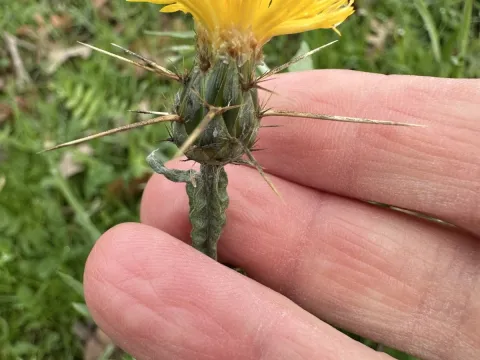
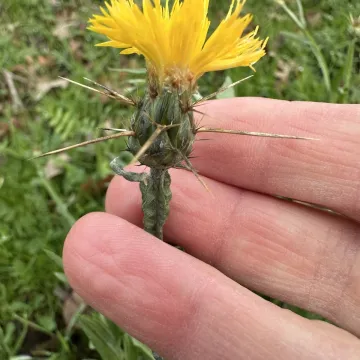
The morphology of the plant includes a stiff, branching stem and bright yellow flowers surrounded by sharp, needle-like spines that deter herbivores. Its taproot can reach depths of up to one meter, allowing it to extract water from deep soil layers. This deep rooting system makes the plant exceptionally drought-tolerant compared to most standard grain crops.
Management strategies focus on early detection and prevention of seed dispersal. Effective control involves a combination of mechanical mowing before flowering, rotational grazing management, and the use of targeted herbicides in the early rosette stage. Ensuring that soil fertility is maintained helps crop plants compete more effectively, reducing the likelihood of weed infestation.
While often viewed negatively due to its invasiveness and injury potential to livestock, Centaurea solstitialis is recognized as a high-quality nectar source for honey bees during the late summer months. In some regions, its honey is considered a valuable secondary product, although this rarely justifies the damage the weed causes to pastures and crop yields.
- Highly invasive nature in non-native ranges.
- Superior drought tolerance through deep taproots.
- Significant competitor for soil moisture in agricultural fields.
- Major source of late-season honey production.
Photo gallery