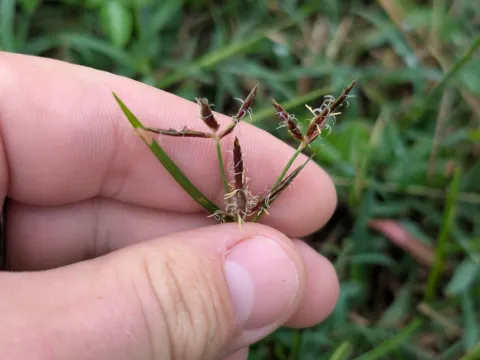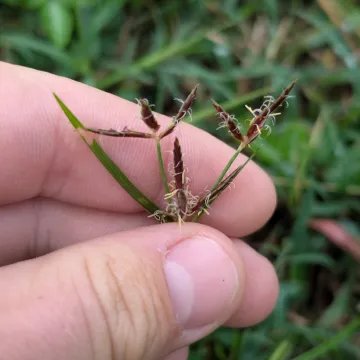
Nut grass
Cyperus rotundus L.
Description
Nut grass (Cyperus rotundus L.) is a perennial herbaceous plant belonging to the sedge family, Cyperaceae. It is widely recognized by agronomists as one of the world's most troublesome weeds, capable of severely impacting crop yields by competing for resources. Despite its pest status, it possesses a complex biological structure that allows it to thrive in diverse environments.
Originally native to tropical and subtropical regions, nut grass has achieved a near-global distribution. It is particularly prevalent in warm climates, where it colonizes agricultural fields, gardens, and lawns. Its resilience is attributed to its ability to survive in a wide range of soil types, from sandy to clay soils, provided there is adequate moisture and sunlight available during the growing season.
Botanically, the plant is distinguished by an intricate root system consisting of rhizomes and small tubers. These tubers act as vital storage organs, allowing the plant to remain dormant during adverse conditions and sprout rapidly when favorable weather returns. The leaves are grass-like and basal, while the stem is triangular in cross-section, which is a key identifying characteristic of the Cyperaceae family.
Agricultural management of nut grass is notoriously difficult. Because of its deep-rooted tubers, mechanical methods like tilling are often ineffective and can even aid in propagation by spreading plant fragments. Integrated weed management programs, combining chemical control with cultural practices such as crop rotation and shading, are usually required to keep infestations under manageable levels.
In terms of хозяйственное (economic) use, the tubers of Cyperus rotundus have been used for centuries in traditional herbal medicine for their therapeutic properties, including digestive support and wound healing. While it is rarely cultivated as a main agricultural crop, its biochemical profile continues to be a subject of interest in pharmaceutical research for potential medicinal applications.
- Highly efficient vegetative reproduction via tubers.
- Significant competition with cash crops for soil nutrients.
- High tolerance to various environmental stressors.
- Complex, deep subterranean rhizome network.
Photo gallery