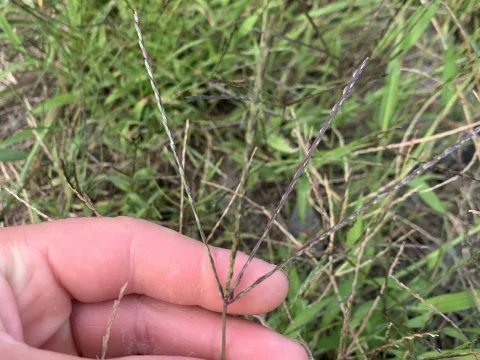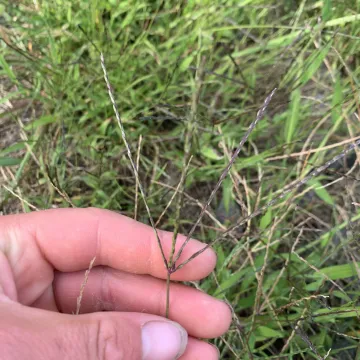
Large crabgrass
Digitaria sanguinalis (L.) Scop.
Description
Large crabgrass (Digitaria sanguinalis) is an annual grass species belonging to the Poaceae family. While it is widely recognized by farmers as a competitive weed that invades cultivated fields and lawns, it possesses biological traits that allow it to serve as forage in specific pasture management systems.
The species is native to Eurasia but has become a global cosmopolitan plant, naturalized in almost all temperate and tropical regions. It thrives in disturbed soils, cultivated areas, and open habitats, showing a remarkable ability to colonize environments where soil exposure and high light availability are present.
Botanically, Digitaria sanguinalis is characterized by its decumbent, spreading stems that root at the lower nodes. The leaves are typically flat and covered with fine, soft hairs. The inflorescence is a digitate raceme consisting of several spike-like branches, which gives the plant its distinct appearance during the reproductive phase.
As a C4 plant, it has a high photosynthetic efficiency in hot, sunny conditions. It requires well-drained, fertile soil to reach its maximum biomass potential. Large crabgrass is sensitive to frost and shade, making it highly dependent on the timing of spring warming and the density of the crop canopy for its survival and proliferation.
In agronomy, it is primarily managed to reduce competition with cash crops like corn and soybeans. However, in low-input farming systems, it provides a source of grazing biomass that is highly palatable to cattle and sheep. Effective management involves a combination of preventative cultural practices and chemical control.
The plant is occasionally susceptible to various fungal pathogens such as rusts and smuts, but its rapid growth rate often allows it to overcome minor infestations. Pest pressure from aphids and mites is common, though rarely sufficient to control its spread without integrated pest management strategies.
Photo gallery