
Blue couch
Digitaria scalarum (Schweinf.) Chiov.
Description
Digitaria scalarum, commonly known as blue couch, is a perennial grass species belonging to the Poaceae family. While it possesses certain grazing qualities, it is most widely recognized in agriculture as a highly persistent and aggressive weed that poses significant challenges in tropical and subtropical farming systems.
Native to tropical Africa, this plant has spread across numerous regions where the climate is warm and humid. It is frequently found as a major pest in various plantation crops, including coffee, tea, and sisal, where it competes aggressively for water and nutrients, often leading to reduced crop yields.
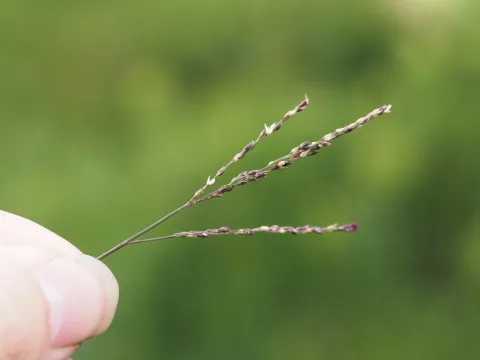
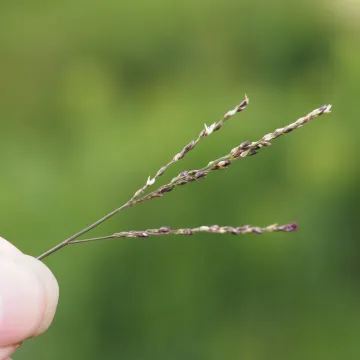
The botanical structure of Digitaria scalarum is characterized by a vigorous rhizomatous root system. These rhizomes allow the plant to creep along and beneath the soil surface, enabling it to survive drought periods and mechanical disturbances. The leaves are typically linear, and the inflorescence consists of racemes that produce numerous small seeds.
The plant thrives in a wide range of soil types, particularly those that are fertile and receive high precipitation. Agronomic management is complex; simple tillage is often ineffective because any remaining rhizome nodes can regenerate into new plants. Integrated weed management, including herbicides and consistent manual weeding, is necessary for effective control.
Regarding its хозяйственное use, while often viewed negatively by crop producers, it serves as a valuable forage grass for livestock in regions where it is not considered invasive. Its primary susceptibility includes various fungal pathogens, such as rusts and smuts, while it may also act as an alternate host for several insect pests common to cereal crops.
Photo gallery