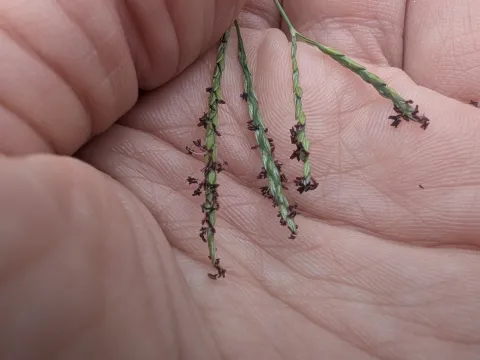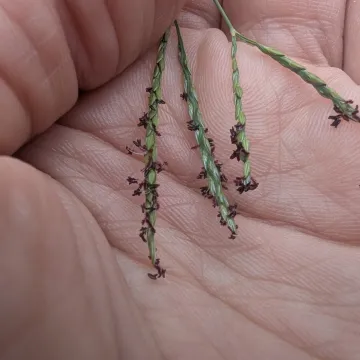
Swaziland fingergrass
Digitaria swazilandensis Stent
Description
Swaziland fingergrass (Digitaria swazilandensis Stent) is a perennial forage crop belonging to the Poaceae (grass) family. This species is recognized for its dense, mat-forming growth habit, facilitated by a network of vigorous stolons that root at the nodes. Its robust ground cover makes it an excellent candidate for both agricultural pasture use and soil stabilization in tropical and subtropical regions.
Native to Southern Africa, this grass has established itself across various regions with warm, frost-free climates. Its natural range encompasses areas where seasonal rainfall supports rapid vegetative growth. Due to its hardiness and ability to thrive in diverse soil types, it has been introduced to other international markets to improve forage yields for livestock production.
Botanically, it features fine-textured foliage that maintains quality even under heavy grazing pressure. The plant’s ability to propagate vegetatively allows it to create a thick turf that outcompetes weeds. This architectural characteristic is vital for maintaining pasture longevity, as it prevents soil compaction and reduces the erosion risks often associated with open range systems.
Agrotechnical management of Swaziland fingergrass requires attention to its preference for warm temperatures and moderate to high light exposure. It thrives best in well-drained, fertile soils but displays sufficient resilience in slightly marginal land. Routine fertilization, particularly with nitrogen, is essential for maintaining protein levels in the forage and ensuring the grass recovers quickly after grazing events.
The primary economic utility of this grass lies in its role as a high-quality pasture source for ruminants. It is favored by farmers for its palatability and sustained productivity.
- Requires periodic mowing or grazing to maintain growth cycles
- Susceptible to specific rust fungi in humid conditions
- Sensitive to frost, which limits its distribution in temperate zones
Photo gallery